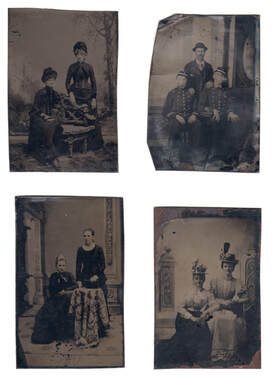
 Tintypes donated by Ed & Marsha Molloy, found when living at 121 N. Hatfield St.
 Guest post by Meguey Baker
Last day as Collections Assistant, Hatfield Historical Museum.
(Meg's contract has ended and we are sorry to see her go!)
One of the challenges about working in museum collections is the process of figuring out the pieces of the puzzle that you don’t have. Artifacts come in, or are found in collections, that tell a part of the story, but not the whole story. So we have to do the research we can based on the clues we have, to expand that story as far as possible without crossing the boundary into conjecture.
Photographs pose a particular puzzle, as sometimes they come in with very little evidence at all. There is only one piece of data here, the name “John” scratched into the face of the photo of the three men, with an “L” beneath it and some additional letters to the right, possibly “Sam” or “Son” or “Som”, and a very faint smudge of what might be a date.
With our modern world being so very full of cameras, on every cell phone as well as other formats, it’s worth remembering that not very long ago, getting one’s photograph taken was rather a big deal, and happened far less frequently, in part because of the trouble and expense involved. One would think that would lead to more careful notation of who is in the photo, and why it was taken; for that, I challenge you to go look at your own childhood photos and see if there is any notation on them. If there’s not, it’s a great time to grab an archival pen and add a few notes to the back; future museum workers will thank you!
Without that first-hand data, of who is in the photo, at least roughly when it was taken, and why, we are back to research and following the leads in the picture itself. When this set of photos came into the Hatfield Historical Museum, we had very little to go on, other than the house location where they were found (121 North Hatfield Road). Here’s where the research took us.
Tintypes first patented in U.S. in 1856
The first step is to narrow down the dates for the type of photograph. These are black and white (or more correctly very dark gray and cream or tan) prints on thin blackened metal sheets. Tintypes like this were first patented in the United States in 1856, but had been patented in France for a few years prior, so the technology was known by 1855. We can use that as our earliest possible circa date. The technique did not actually usually involve tin, but very thin sheets of blackened iron, cut with tin-snips.
A more expensive technique developed in the 1830s, daguerreotypes, required silver-washed copper and a protective glass cover; tintypes were cheaper and the image didn’t disappear at certain angles. If you look carefully at the photo of the three men, you can see an oval of wear on the sheet, where a frame or glass cover has rubbed at the bottom left and protected the tops of the center columns on the painted background from fading as much as the parts that would show through the frame. This also helps account for the uneven edges; it wasn’t meant to show to the edge, it was meant to be in a nice little frame, like the ‘books’ that daguerreotypes made so popular.
Given the dates of technology origin, and hazarding to guess they were taken in America, we can settle on 1855 or after for the whole lot. We could stop there! Tintypes peak in popularity just before the Civil War, but remain around up to the early 1900s, increasingly as a novelty, like photo-booth photos are today. However, if we want to try to dig a little deeper, we can examine the clothes for hints. Each era in history has at least a few distinct silhouettes, and certain things, like hoop skirts and zippers, have extremely clear start dates. Let's look at them in order, by the clues in the clothing.
Last day as Collections Assistant, Hatfield Historical Museum.
(Meg's contract has ended and we are sorry to see her go!)
One of the challenges about working in museum collections is the process of figuring out the pieces of the puzzle that you don’t have. Artifacts come in, or are found in collections, that tell a part of the story, but not the whole story. So we have to do the research we can based on the clues we have, to expand that story as far as possible without crossing the boundary into conjecture.
Photographs pose a particular puzzle, as sometimes they come in with very little evidence at all. There is only one piece of data here, the name “John” scratched into the face of the photo of the three men, with an “L” beneath it and some additional letters to the right, possibly “Sam” or “Son” or “Som”, and a very faint smudge of what might be a date.
With our modern world being so very full of cameras, on every cell phone as well as other formats, it’s worth remembering that not very long ago, getting one’s photograph taken was rather a big deal, and happened far less frequently, in part because of the trouble and expense involved. One would think that would lead to more careful notation of who is in the photo, and why it was taken; for that, I challenge you to go look at your own childhood photos and see if there is any notation on them. If there’s not, it’s a great time to grab an archival pen and add a few notes to the back; future museum workers will thank you!
Without that first-hand data, of who is in the photo, at least roughly when it was taken, and why, we are back to research and following the leads in the picture itself. When this set of photos came into the Hatfield Historical Museum, we had very little to go on, other than the house location where they were found (121 North Hatfield Road). Here’s where the research took us.
Tintypes first patented in U.S. in 1856
The first step is to narrow down the dates for the type of photograph. These are black and white (or more correctly very dark gray and cream or tan) prints on thin blackened metal sheets. Tintypes like this were first patented in the United States in 1856, but had been patented in France for a few years prior, so the technology was known by 1855. We can use that as our earliest possible circa date. The technique did not actually usually involve tin, but very thin sheets of blackened iron, cut with tin-snips.
A more expensive technique developed in the 1830s, daguerreotypes, required silver-washed copper and a protective glass cover; tintypes were cheaper and the image didn’t disappear at certain angles. If you look carefully at the photo of the three men, you can see an oval of wear on the sheet, where a frame or glass cover has rubbed at the bottom left and protected the tops of the center columns on the painted background from fading as much as the parts that would show through the frame. This also helps account for the uneven edges; it wasn’t meant to show to the edge, it was meant to be in a nice little frame, like the ‘books’ that daguerreotypes made so popular.
Given the dates of technology origin, and hazarding to guess they were taken in America, we can settle on 1855 or after for the whole lot. We could stop there! Tintypes peak in popularity just before the Civil War, but remain around up to the early 1900s, increasingly as a novelty, like photo-booth photos are today. However, if we want to try to dig a little deeper, we can examine the clothes for hints. Each era in history has at least a few distinct silhouettes, and certain things, like hoop skirts and zippers, have extremely clear start dates. Let's look at them in order, by the clues in the clothing.
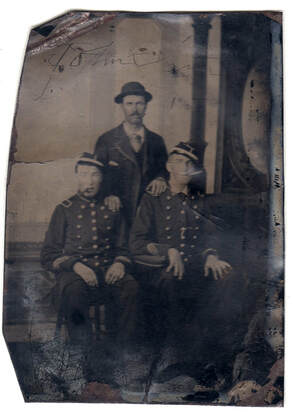
The most obvious is the military attire on the two younger men. This type of button pattern, with the center line and the two outer lines that curve out from the waist and back in towards the neck, occurs in a very few places: private military academies in the 1860s, in which case there is generally a great deal of decorative braid, often in contrasting colors, and the New England Militia in the 1860s, which had no such braid.
The decorations on the young men’s jackets also include shoulder boxes, indicating they are Lieutenants in the U.S. Army, and they have inverted chevrons on the sleeve cuffs we can see -- the boy on the left has two, the boy on the right has three. If these are measures of rank, the boy on the left is a corporal and the boy on the right a sergeant. All this is slightly confusing -- how wonderful it would be if someone had taped a little note to the back of this metal plate, with the date, names and ranks of these boys on it!
Why have I switched to calling them boys, instead of young men? Look at their faces and the positioning of their bodies. These are young, very young, men. The cigar that seems reasonable in the mouth of the mustachioed man behind them looks unfamiliar in the mouth of the boy on the right, and ridiculous in the mouth of the boy on the left. The positioning of the older man’s hands on the boys shoulders is also intentional, not just to hold them steady, but to indicate relationship. Using the clues in the technology and the clothing, we can deduce a possible reason for this photo shoot: these young men are off to the Civil War, which started in 1861, and swept up so many young men and boys.
The decorations on the young men’s jackets also include shoulder boxes, indicating they are Lieutenants in the U.S. Army, and they have inverted chevrons on the sleeve cuffs we can see -- the boy on the left has two, the boy on the right has three. If these are measures of rank, the boy on the left is a corporal and the boy on the right a sergeant. All this is slightly confusing -- how wonderful it would be if someone had taped a little note to the back of this metal plate, with the date, names and ranks of these boys on it!
Why have I switched to calling them boys, instead of young men? Look at their faces and the positioning of their bodies. These are young, very young, men. The cigar that seems reasonable in the mouth of the mustachioed man behind them looks unfamiliar in the mouth of the boy on the right, and ridiculous in the mouth of the boy on the left. The positioning of the older man’s hands on the boys shoulders is also intentional, not just to hold them steady, but to indicate relationship. Using the clues in the technology and the clothing, we can deduce a possible reason for this photo shoot: these young men are off to the Civil War, which started in 1861, and swept up so many young men and boys.
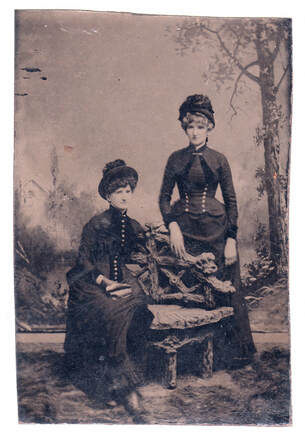
Next, let’s look at the women in the dark two-piece dresses, with tight-fitting bodices, buttons up the front and their hats on the backs of their heads. So many clues! The sleeves are very snug, but with a natural shoulder, which marks it as post-1870, as the pre-Civil War shoulder was very low off the shoulder, with a wider sleeve.
The large full skirts of the 1850s and 1860s are gone, and the buttons and trim on both women’s bodices are heavily influenced by military uniform styles. Given the very upright postures of both woman, there is boning in the bodices, and very likely short corsets.
It’s unclear if there is a bustle on either dress, but from the way the skirt on the seated woman is pulling, we can estimate the fullness of the fabric, and deduce that it’s an A-line style skirt with a ruffle at the hem, with an overskirt that adds a draped front. The rustic bench and backdrop of trees implies an outdoor theme, and so they are wearing their hats. The hats are dark straw, and have dark feathers and ribbons, secured with hat pins instead of ribbon ties. Hatpins were first made commercially in the 1850s, and widely adopted following the Civil War, remaining a constant in women’s accessories until the first World War, when the demand for metal affected every aspect of life. All of this points to a circa 1870 date for the ladies in dark hats.
The large full skirts of the 1850s and 1860s are gone, and the buttons and trim on both women’s bodices are heavily influenced by military uniform styles. Given the very upright postures of both woman, there is boning in the bodices, and very likely short corsets.
It’s unclear if there is a bustle on either dress, but from the way the skirt on the seated woman is pulling, we can estimate the fullness of the fabric, and deduce that it’s an A-line style skirt with a ruffle at the hem, with an overskirt that adds a draped front. The rustic bench and backdrop of trees implies an outdoor theme, and so they are wearing their hats. The hats are dark straw, and have dark feathers and ribbons, secured with hat pins instead of ribbon ties. Hatpins were first made commercially in the 1850s, and widely adopted following the Civil War, remaining a constant in women’s accessories until the first World War, when the demand for metal affected every aspect of life. All of this points to a circa 1870 date for the ladies in dark hats.
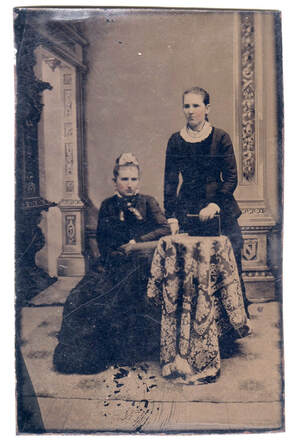
The second picture of ladies in dark dresses, with a little table, shows women wearing the Basque waist, which extends below the waist down to the hips, and lends a slight forward slope to the torso. A precursor of the Edwardian S-shape torso, this silhouette has a more relaxed sleeve, a natural waist, longer boning and slightly longer skirts.
As this is an indoor setting, and these are young ladies, they have minimal hairdressing -- braids and ribbons, and white collars to set off the dark fabric. All of this points to a circa date of 1880.
The last photo (below) is significantly later, with women in separates with hats square on their heads.
As this is an indoor setting, and these are young ladies, they have minimal hairdressing -- braids and ribbons, and white collars to set off the dark fabric. All of this points to a circa date of 1880.
The last photo (below) is significantly later, with women in separates with hats square on their heads.
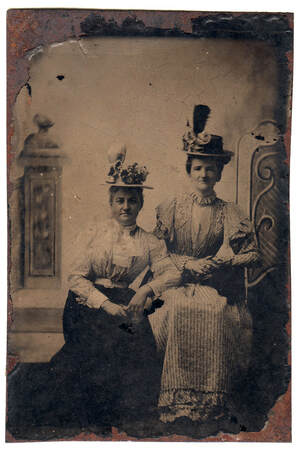
There is extra fullness in the upper arm, but as it tapers to the cuff instead of going sharply from full in the upper arm and tight in the lower arm, we can date these fairly closely.
The woman on the left wears a dark skirt and light blouse, with a soft pale cravat, which points to the menswear influence of 1900. But the layers of lace on the lighter two-piece dress on the woman on the right is closer to the 1905-1910 bodice.
The light straw hats with very upright plumes in wide ribbon hat bands are very 1900s "girl-on-the-go," but hats vary dramatically as a personal expression throughout the 1890s to 1910. So, we could say that this is a picture of two friends, one of them wearing an old favorite outfit and one wearing a newer fashion, but certainly within scope of a 1905 circa date.
By carefully examining the details in the clothing, we can bring these four photos from “after 1850” to a more precise chronological timeline, and make some inferences about the people shown. Still, it would sure be helpful if there was a good clear pencil notation on the back, or notes that had come down with these over the last 150+ years.
The woman on the left wears a dark skirt and light blouse, with a soft pale cravat, which points to the menswear influence of 1900. But the layers of lace on the lighter two-piece dress on the woman on the right is closer to the 1905-1910 bodice.
The light straw hats with very upright plumes in wide ribbon hat bands are very 1900s "girl-on-the-go," but hats vary dramatically as a personal expression throughout the 1890s to 1910. So, we could say that this is a picture of two friends, one of them wearing an old favorite outfit and one wearing a newer fashion, but certainly within scope of a 1905 circa date.
By carefully examining the details in the clothing, we can bring these four photos from “after 1850” to a more precise chronological timeline, and make some inferences about the people shown. Still, it would sure be helpful if there was a good clear pencil notation on the back, or notes that had come down with these over the last 150+ years.
Author
Meguey Baker studied early American textile history and material culture at Hampshire College. She is a member of the Mohawk Trail Quilt Guild, on the board of the Historical Society of Greenfield, and does textile repair and conservation for private clients.
Meguey Baker studied early American textile history and material culture at Hampshire College. She is a member of the Mohawk Trail Quilt Guild, on the board of the Historical Society of Greenfield, and does textile repair and conservation for private clients.