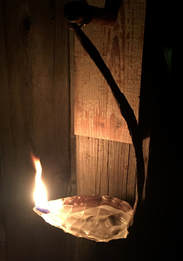
 Reproductioin of 17th c. "fat lamp," by Bob Osley.
 Guest post by Rob Wilson
Hatfield Historical Society volunteer
This Dec. 23, at Hatfield’s Annual Luminarium celebration, thousands of flickering homemade candle lanterns will line sidewalks and driveways and shine from front door stoops. Once the wicks burn down and splutter out, however, it will be back to using electric-powered lights to push back the winter night. To truly appreciate that luxury, look back for a moment on the times before a click of an electric switch could turn darkness into light. The history of illuminating Hatfield—from Colonial-era candle and lamp light all the way to the electrical service we all enjoy today— offers some interesting examples of how evolving science and technology have significantly changed our lives.
Hatfield Historical Society volunteer
This Dec. 23, at Hatfield’s Annual Luminarium celebration, thousands of flickering homemade candle lanterns will line sidewalks and driveways and shine from front door stoops. Once the wicks burn down and splutter out, however, it will be back to using electric-powered lights to push back the winter night. To truly appreciate that luxury, look back for a moment on the times before a click of an electric switch could turn darkness into light. The history of illuminating Hatfield—from Colonial-era candle and lamp light all the way to the electrical service we all enjoy today— offers some interesting examples of how evolving science and technology have significantly changed our lives.
From the time pioneers of European heritage settled in the area and eventually founded Hatfield, in 1670, and all the way into the 1850s, town residents lit up their homes with candles and lamps that burned oil. The various lamps made light from animal fats (oil derived from beef and sheep fat, when mixed together, burned best), beeswax, fish oil and whale oil. Candles were used less as lamps became more efficient and brighter. Whale oil, which burned brighter and cleaner than its counterparts, was the high-end lighting choice for much of that time period, but because of its cost was mostly used in wealthier households.
In the mid-1800s, scientists developed a process for making lamp oil from coal, and kerosene was born. As manufacturing processes were improved, kerosene became more affordable and its use for lighting became widespread. As they lit their lamps, however, Hatfield residents, wished for a brighter and easier means of lighting their homes. “The lampshade or chimney had to be washed daily and the kerosene filled when necessary,” observed Nellie Donnis Gutfinski in her memoir about Hatfield life, Times Remembered: Growing Up in the Donnis Household. “One could smell the kerosene when the lamp was in use.” That odor permeated her house until the early 1920s, Nellie remembered, until electric lines finally reached her neighborhood and her house was wired.
A brighter, cleaner and less odoriferous alternative to the kerosene lamp actually had been introduced to town residents in the late 1860s: gas lighting. Small gas-producing systems usually were utilized to light a single building. There was one catch, however. Only Hatfield’s well-off households and businesses could afford to upgrade.
In the mid-1800s, scientists developed a process for making lamp oil from coal, and kerosene was born. As manufacturing processes were improved, kerosene became more affordable and its use for lighting became widespread. As they lit their lamps, however, Hatfield residents, wished for a brighter and easier means of lighting their homes. “The lampshade or chimney had to be washed daily and the kerosene filled when necessary,” observed Nellie Donnis Gutfinski in her memoir about Hatfield life, Times Remembered: Growing Up in the Donnis Household. “One could smell the kerosene when the lamp was in use.” That odor permeated her house until the early 1920s, Nellie remembered, until electric lines finally reached her neighborhood and her house was wired.
A brighter, cleaner and less odoriferous alternative to the kerosene lamp actually had been introduced to town residents in the late 1860s: gas lighting. Small gas-producing systems usually were utilized to light a single building. There was one catch, however. Only Hatfield’s well-off households and businesses could afford to upgrade.
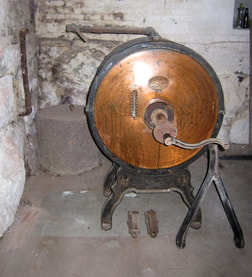 Air pump and weight from Lowell Mansion. Photo by Mark Gelotte, courtesy of Carol Benson.
 The Lowell Mansion, built in 1868 on Elm Street, utilized one of the expensive home-based systems. The machinery used gravity-driven technology to pump air through a petroleum-based liquid, producing a burnable gas that it collected and pushed through pipes to wall fixtures and ornamental sconces. Gas flame was considerably brighter than the light of an oil lamp. Although the system was replaced by electric lights a century ago, the mansion’s gas fixtures remain as a reminder of a largely forgotten past.
A much more affordable form of gas lighting became available to some Hatfield residents in the early 20th century. Coal gas had been produced in commercial gasworks, delivered to customers in underground pipes, and used to light large American cities and towns since 1816. Later in the century, the more flammable and brighter burning acetylene gas was introduced. As large-scale gas-making technology advanced, small towns began installing systems and laying pipes.
It’s unclear exactly when that type of gas lighting first was utilized in Hatfield. According to A History of Hatfield in Three Parts, by Daniel White Wells and Reuben Field Wells, published in 1910, the town’s first streetlights were erected in the 1890s, “at intervals along several of the streets in the center of the village and the lamps were lit and cared for by property owners on whose places they were located.” However, the author did not mention if they burned gas or some other fuel.
The first Hatfield gas-making facility that Wells mentions began making acetylene gas in 1901, to light the Congregational Church. Perhaps inspired by the success of the church’s system, Wells teamed with several wealthy peers, in 1903, to finance and build an acetylene gasworks on Prospect Street.
A much more affordable form of gas lighting became available to some Hatfield residents in the early 20th century. Coal gas had been produced in commercial gasworks, delivered to customers in underground pipes, and used to light large American cities and towns since 1816. Later in the century, the more flammable and brighter burning acetylene gas was introduced. As large-scale gas-making technology advanced, small towns began installing systems and laying pipes.
It’s unclear exactly when that type of gas lighting first was utilized in Hatfield. According to A History of Hatfield in Three Parts, by Daniel White Wells and Reuben Field Wells, published in 1910, the town’s first streetlights were erected in the 1890s, “at intervals along several of the streets in the center of the village and the lamps were lit and cared for by property owners on whose places they were located.” However, the author did not mention if they burned gas or some other fuel.
The first Hatfield gas-making facility that Wells mentions began making acetylene gas in 1901, to light the Congregational Church. Perhaps inspired by the success of the church’s system, Wells teamed with several wealthy peers, in 1903, to finance and build an acetylene gasworks on Prospect Street.
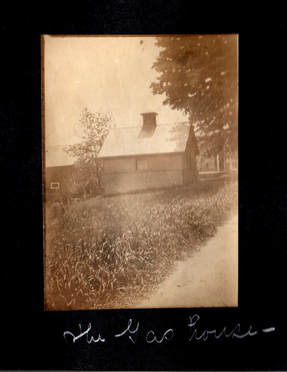
Gas house, Prospect St., Hatfield, courtesy of the Byrne Family
Incorporated as the Hatfield Gas Works in 1904, the facility used a process that forced calcium carbide through water, captured the resulting gas, and then piped it to customers. Awarded a contract to provide gas for the town’s streetlamps, the company laid underground gas pipes and also began to service some homes and businesses.
Electric power arrived in Hatfield in 1907, delivered by lines spanned across the Connecticut River by the Amherst Gas Co., one of the many American gas utilities to expand into delivering electrical service. Streetlights burning incandescent light bulbs began to supplant the town’s gas lamps and, as Wells noted in his History of Hatfield, the new and ever-growing electric infrastructure soon extended beyond the reach of his company’s acetylene gas pipes.
The expansion of electric service in Hatfield was costly, however, and it proceeded slowly. Hatfield Gas Co., taken over by the larger Massachusetts Lighting Co. in 1909, was able to expand its customer base, as more households within reach of the plant’s delivery system adopted gas for cooking and some lighting. A statewide report on electric utilities revealed that the company jumped its 1912 sales by 36% from its 1909-1910 figure, to $46,550. Adjusted for inflation, today that amount would translate to about $1,244,000.
Yet the heyday of localized production of coal and acetylene gas for lighting purposes was over. Over the next three decades, more and more Hatfield households began lighting with electricity. Once electric power was delivered to a home, it was carried room-to-room by “knob and tube” (K&T) wiring (see illustration).
Electric power arrived in Hatfield in 1907, delivered by lines spanned across the Connecticut River by the Amherst Gas Co., one of the many American gas utilities to expand into delivering electrical service. Streetlights burning incandescent light bulbs began to supplant the town’s gas lamps and, as Wells noted in his History of Hatfield, the new and ever-growing electric infrastructure soon extended beyond the reach of his company’s acetylene gas pipes.
The expansion of electric service in Hatfield was costly, however, and it proceeded slowly. Hatfield Gas Co., taken over by the larger Massachusetts Lighting Co. in 1909, was able to expand its customer base, as more households within reach of the plant’s delivery system adopted gas for cooking and some lighting. A statewide report on electric utilities revealed that the company jumped its 1912 sales by 36% from its 1909-1910 figure, to $46,550. Adjusted for inflation, today that amount would translate to about $1,244,000.
Yet the heyday of localized production of coal and acetylene gas for lighting purposes was over. Over the next three decades, more and more Hatfield households began lighting with electricity. Once electric power was delivered to a home, it was carried room-to-room by “knob and tube” (K&T) wiring (see illustration).
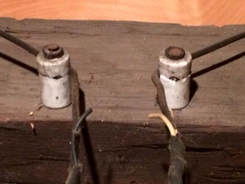
Photo by George Vachula
Electric current traveled to a light fixture or a wall outlet in one insulated copper wire and returned on a separate parallel wire. The wires were three or four inches apart and each was secured to walls and ceilings with a series of non-conducting porcelain knobs that were affixed with a nail. The wire ran through walls and wooden beams and joists in a porcelain tube.
Although K&T signaled a revolution in home lighting and living, the service it provided was Spartan compared with today’s electrical wiring. Pat (Labbee) Cady remembered visiting her grandparents’ house (now 60 School St.) as a child. It featured “one ungrounded outlet upstairs, and sconces in the living room that were originally for kerosene,” as well as “extension cords under carpets.” Hatfield resident Al Rejniak, in another interview, described the early electrical setup in his home: “All we had was one pull chain, hanging in the middle of each room, no outlets.”
Many residents of outlying Hatfield neighborhoods had a decades-long wait for electric lines and service. Others waited until they could better afford it. North Hatfield’s Paul Vachula family wasn’t able to trade their kerosene lamps for electric lights until 1928. At least some homes on Dwight Street and the Marcinowski Farm on Valley Street didn’t get electric lights until the mid-1930s. But electricity had arrived and was here to stay. And as a result, life in Hatfield – in spite of all the pull chains and extension cords – got a whole lot easier.
Rob Wilson is the former executive director of the Veterans Education Project, a nonprofit based in Amherst, MA, and resides in Hatfield, MA.
Although K&T signaled a revolution in home lighting and living, the service it provided was Spartan compared with today’s electrical wiring. Pat (Labbee) Cady remembered visiting her grandparents’ house (now 60 School St.) as a child. It featured “one ungrounded outlet upstairs, and sconces in the living room that were originally for kerosene,” as well as “extension cords under carpets.” Hatfield resident Al Rejniak, in another interview, described the early electrical setup in his home: “All we had was one pull chain, hanging in the middle of each room, no outlets.”
Many residents of outlying Hatfield neighborhoods had a decades-long wait for electric lines and service. Others waited until they could better afford it. North Hatfield’s Paul Vachula family wasn’t able to trade their kerosene lamps for electric lights until 1928. At least some homes on Dwight Street and the Marcinowski Farm on Valley Street didn’t get electric lights until the mid-1930s. But electricity had arrived and was here to stay. And as a result, life in Hatfield – in spite of all the pull chains and extension cords – got a whole lot easier.
Rob Wilson is the former executive director of the Veterans Education Project, a nonprofit based in Amherst, MA, and resides in Hatfield, MA.