Check us out on social media
hatfield historical society
  • Home
  • Events
    • Visitors and Workers
  • Collections
    • Foxfire Reports
    • Audio Stories
    • Profiles
  • Resources
    • Transciptions
    • Genealogy
  • Partners
  • Volunteers
  • Blog
  • Contact Us
    • Contact Us
    • Directions
    • Museum Shop
  • DONATE / JOIN
    • Membership
    • Donations
  • Farm Museum CPA
  • Link Page

Public grief and the blue star flag

9/19/2018

0 Comments

 
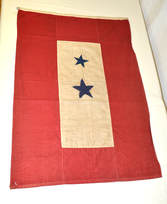
PictureBardwell WWI service flag
Guest post by Meguey Baker
Collections Assistant, Hatfield Historical Museum


The idea of social grief, that we are or could be united by loss, was an important part of the makeup of the 20th century. Yesterday in the Hatfield Historical Museum we inventoried the flags and banners from our textile collection. There are many, but the one that stopped me was this one: the World War I Service flag for Homer Bardwell and Curtis Bardwell (below).

These flags were used to signify the homes of people in the military. A blue star was for a person serving, a gold star was for a person who had died in service, a gold cross for a person injured in service. Some homes had one star, others had several. All of them helped those passing by to understand that this family was thinking of someone far away, possibly in harm’s way. This helped form a community and support for families if anything in the news was cause for alarm. If a family had a blue star and then it was replaced with a gold star, everyone knew what had happened. Everyone could be extra considerate and compassionate with the grieving family.
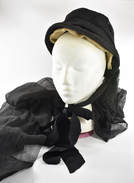
Picture19th century mourning wear
Also recently in the museum, we inventoried all of the hats, including an entire box of black mourning wear. Black hats, black bonnets with long black veils, black ribbon collars, dull black bands and black net shawls. There was a whole system of mourning wear, from deepest black through dark purple to lavender to gray and white. Colors would return as you felt able or after commonly accepted lengths of time.  Whole industries grew up around this, with whole methods of fabric production. Mourning wear served the same purpose for grieving individuals that blue star and gold star flags served for families. Beyond the message to people passing by the house, this mourning wear alerted everyone you interacted with throughout your day that you were in grief, and to perhaps be understanding if you took a little more time to do a simple task, or suddenly teared up for no clear reason.

PictureRuth Withun Lord, died 2007
I miss this. A dozen years ago, my family went through a long hard period of loss. In 18 months, I lost three grandparents (including my grandmother at left), my father-in-law, and two brothers-in-law. I remember standing at the counter at the gas station, trying to complete the exchange, and wishing so very much that I could be wearing a black mourning band or veil so that people would know, without me having to tell them, that I was bearing up under the pain of loss, and they might be more patient with me. I wanted to see other people around town wearing black or sober clothes, to have some sense of not being alone in the depths of my grief. Even if I did not know them, to have seen other people walking around with clear signifiers of loss and grief would have been a tremendous comfort.

We want comforting when we are grieving, and we want to know we are not alone when we are feeling so bereft. During many of our nation’s wars, the names of the injured and dead were published in the local papers, and buildings and people were visibly marked by loss. We have in our collective memory black-draped hearses and Jackie Kennedy in a black hat and sheer black veil, flag-draped coffins and candle-light vigils. Maybe sometime we will again have a way for people to convey their personal grief with the same simple wordless dignity that a WWI Service flag or a black armband gave to those in decades past. For now, let us remember that no matter what people are wearing, some of those we see each day are suffering great loss and none of us are or need to be alone in our sorrow.

Author

Meguey Baker studied early American textile history and material culture at Hampshire College. She is a member of the Mohawk Trail Quilt Guild, on the board of the Historical Society of Greenfield, and does textile repair and conservation for private clients.
0 Comments

In-Flew-Enza: The Deadly Pandemic Strikes Hatfield

1/11/2016

3 Comments

 
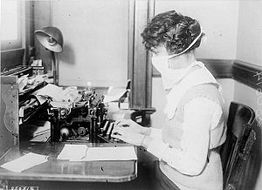
PictureNew York City typist, Oct. 16, 1918. Source: National Archives
By Deb Blodgett
 
If you were a child skipping rope in Hatfield in 1918, you might have recited this popular rhyme:
 
I had a little bird,
Its name was Enza.
I opened the window,
And in-flew-enza.
 
The year 1918 marked the beginning of a worldwide epidemic that later became known as the Influenza Pandemic of 1918-1919. While it is easy to think that this epidemic only impacted large overcrowded cities, this simply was not the case. Hatfield, like many small rural towns, was not left unscathed.  
 
Although the disease was called the “Spanish Flu,” the name was a misnomer. During World War I, the United States and several European countries censored news about the influenza epidemic, fearing additional panic or adverse impact on soldier morale. During the war, Spain remained neutral, which resulted in its newspapers freely reporting news of the influenza epidemic. This incorrectly led many to believe Spain was the origin of the disease, or more severely impacted than other countries, which was not the case. In fact, an estimated one-third of the world’s population, about 500 million, became infected and the total deaths due to influenza were tallied between 50 and 100 million people during the approximately six months of the pandemic spanning late 1918 and early 1919. About 675,000 of these deaths occurred in the United States.

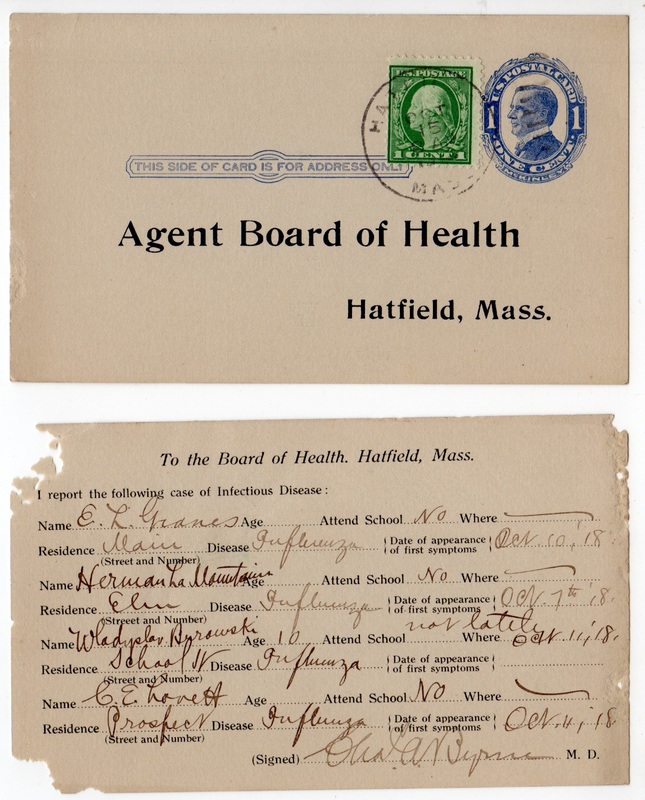
PictureOctober 1918 notice of influenza cases. Click for larger image.
In Massachusetts, it was conservatively reported that 400,000 became infected between September and December of 1918. As many physicians and nurses were enlisted in the military, the number of available medical professionals available to battle this illness was reduced. In addition, hospital facilities throughout the state were sorely unprepared to accommodate the sizable number of cases, prompting the establishment of about 50 emergency hospitals throughout the state. The most dramatic impact occurred in October 1918 with an average of 418 deaths occurring per day. The total Massachusetts deaths attributable to influenza in 1918 totaled 13,783. However, an additional 4,643 deaths listed influenza as a secondary cause of death, bringing the total impact of influenza-related deaths to 18,426.  In 1919, there were 2,872 deaths attributable to influenza. The expense to the Massachusetts government in fighting the influenza outbreak amounted to about $100,000 in 1918. (That would be about $1.6 million in today’s dollars.)

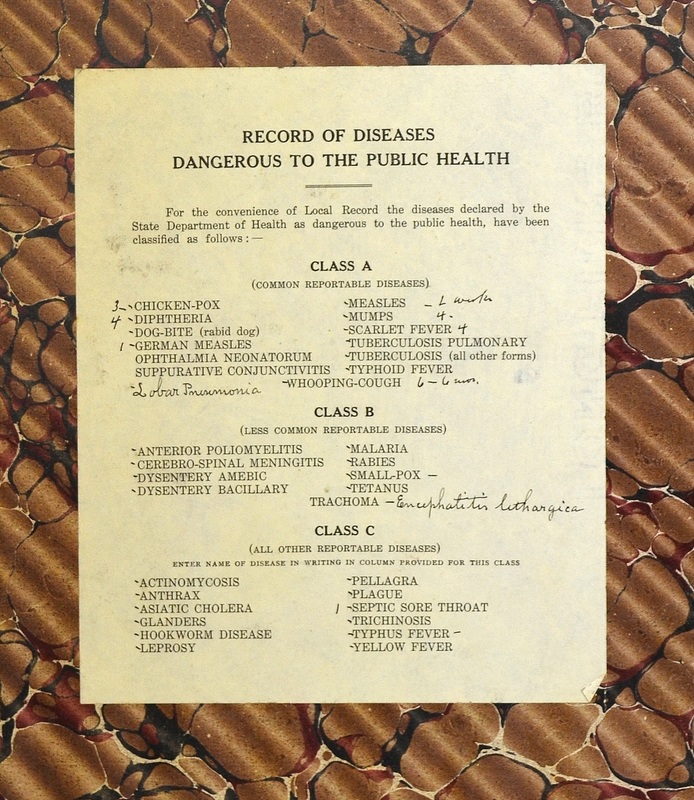
PictureInside cover, Hatfield's Dangerous Diseases record book
Beginning in 1884, Massachusetts law required town board of health officials to keep a record of residents infected with diseases deemed dangerous to public health. Bound books were provided by the state printing office to each town for this purpose so as to provide consistency in data reporting. These log books included spaces to record the disease contracted, as well as the impacted individual’s name, age, occupation, address, reporting individual, and disposition. However, before September 1918, influenza was not one of the reportable diseases as it was not considered dangerous to public health before the 1918 strain.

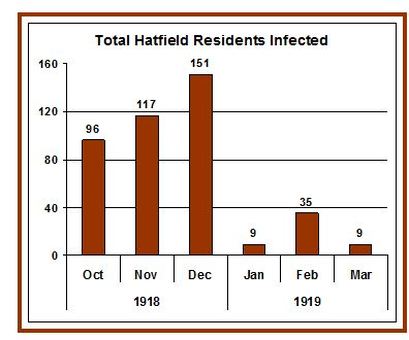
Fortunately, the Record of Dangerous Diseases, Town of Hatfield, still exists, thus allowing us to examine how the town was impacted by the epidemic. Hatfield’s first reported case of influenza occurred on Oct. 8, 1918, infecting a 26-year-old male. By Dec. 31, a total of 364 residents had contracted the illness, nearly 14% of the town’s population. An additional 53 cases occurred in the first few months of 1919, with the last cases being reported on March 24, 1919. A total of 417 residents became ill during the six months of the epidemic (see below):
Picture
A total of 417 residents contracted influenza in the six months of the epidemic.
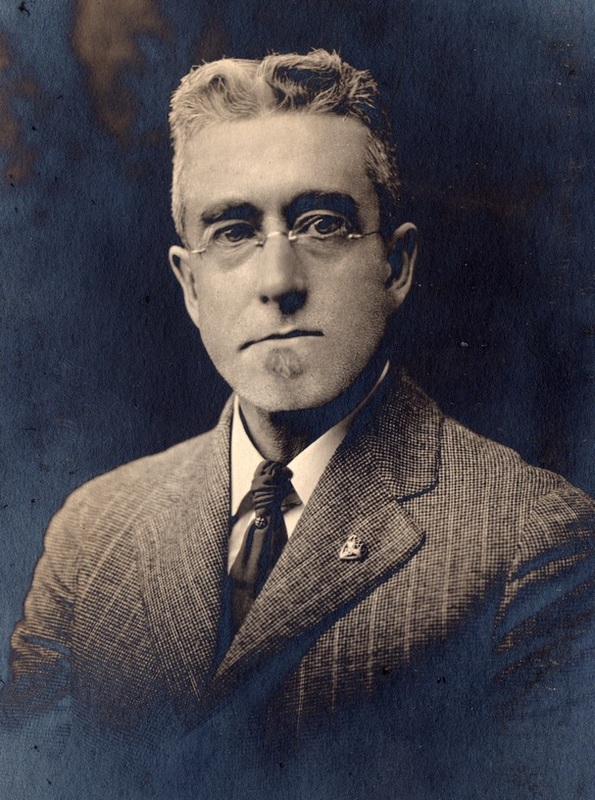
PictureDr. C. A. Byrne, c. 1915
One of Hatfield’s two in-town physicians, Dr. Charles A. Byrne, treated 82% of the town’s infected residents with the remaining residents being treated by doctors from Northampton and other area towns. The town’s other in-town doctor, Dr. Alfred Bonneville, was away serving in World War I in the Medical Corps. While not all of the residents’ ages were reported, of those that were, the youngest patient was 9 months old and the eldest patient was 50 years old. It is likely that most infected patients were between the ages of 20 and 40, which is the typical age group that this strain of influenza affected.

Hatfield was fortunate that the majority of its impacted residents recovered.  Influenza-related deaths were low, with six deaths having occurred in 1918 (although, as discussed above, an additional five deaths may have had influenza as a contributing factor) and no deaths by influenza in 1919.
Picture
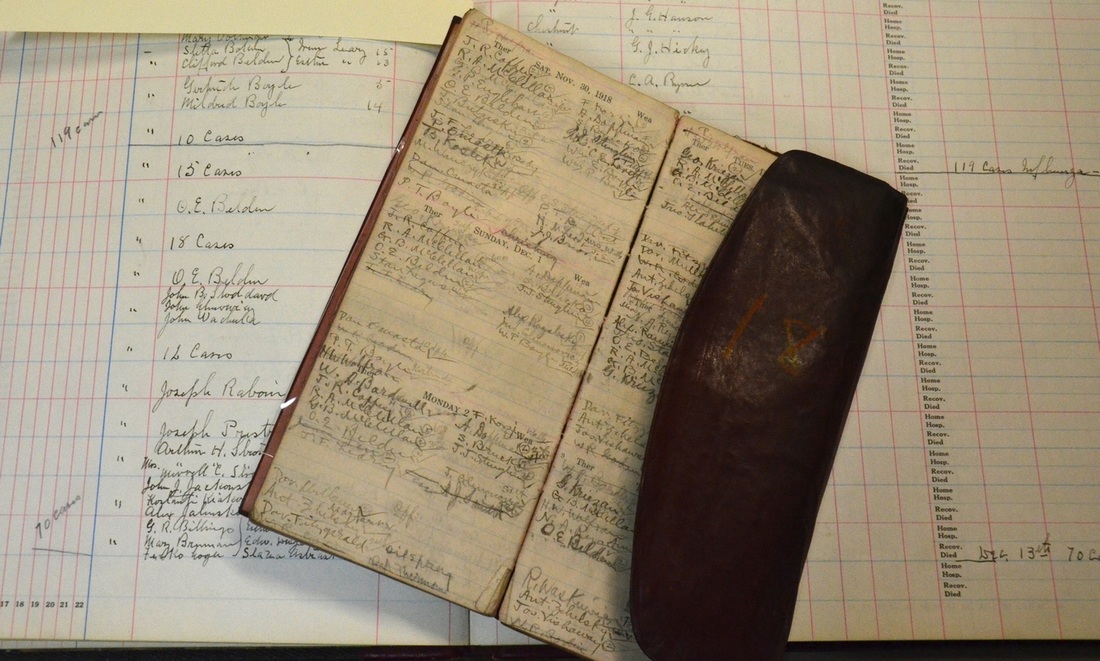
Dr. C.A. Byrne's appointment book, Nov. 30-Dec. 2, 1918, and the Town of Hatfield's influenza record.
Deb Blodgett is a volunteer at the Hatfield Historical Museum. She enjoys historical and genealogical research, and her interests include the study of artifacts, industries and family life of rural 19th century New England.

*For more information about health care in Hatfield in the first half of the 20th century, check out the following post about our Mass Humanities Scholar in Residence Grant as well as a guest blog post by our summer Scholar in Residence, UMass PhD candidate Ann Robinson, and visit the Hatfield Historical Museum’s current exhibit “From House Calls to Hoaxes: The Changing Face of Health Care in Hatfield.” 
Picture
Sources:
1. Jeffery K. Taubenberger and David M. Morens, “1918 Influenza: the Mother of All Pandemics”, Emerging Infectious Diseases, 12:1 (2006): 15-22.
2. Laura Stephenson Carter, “Cold Comfort,” Dartmouth Medicine, (Winter 2006): 36-57.
3. Harold D. Wilson, ed., Seventy-Seventh Annual Report on the Vital Statistics of Massachusetts…for the Year 1918 (Boston: Wright & Potter Printing Co., 1920), 94, 180, 190, 199, 241.
4. Annual Report on the Vital Statistics of Massachusetts…for the Year 1919 (Boston: Wright & Potter Printing Co., 1921), 99, 191.
5. The Revised Laws of the Commonwealth of Massachusetts Enacted November 21, 1901 … (Boston: Wright & Potter Printing Co., 1902), Chapter 75, Section 51, 666.
6. Fourth Annual Report of the State Department of Health of Massachusetts (Boston: Wright & Potter Printing Co., 1919), 3-6.
7. Record of Diseases Dangerous to Public Health, Town of Hatfield, 1915-1944, original manuscript, Hatfield, Massachusetts.

3 Comments

Why are we here?

11/22/2015

 
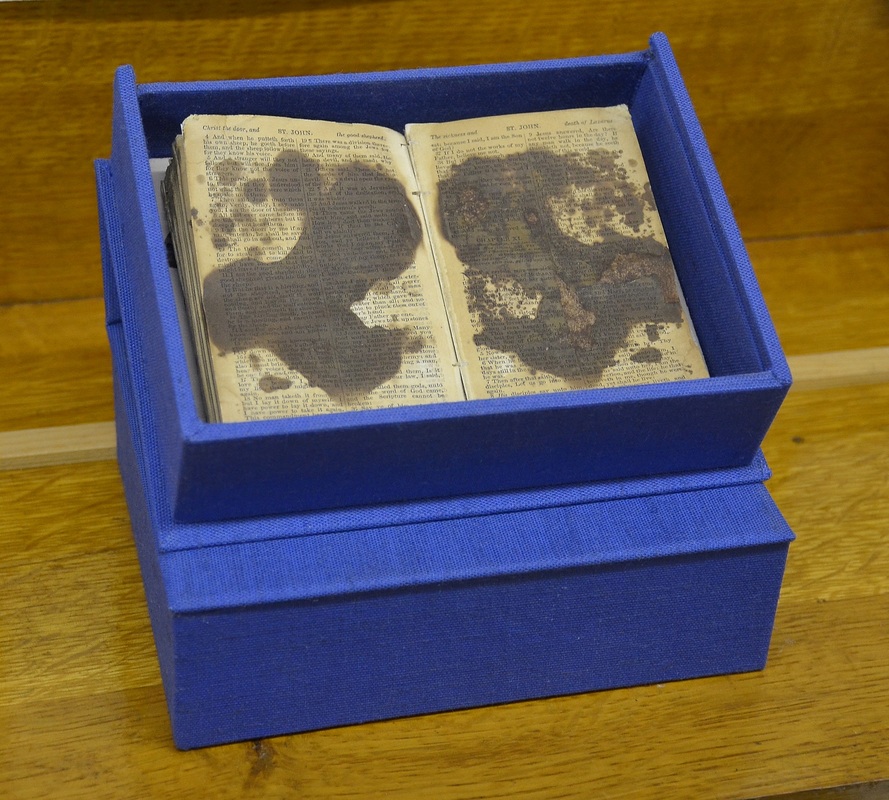
PictureCivil War Bible (click for larger image)
 It was three 5th and 6th grade girls and our town clerk who made my day last Tuesday, helping to answer the question: Why do we save items from our town’s history, anyway? Why not just send folks to the Internet, where they can read up on wars, migrations and how things used to be?

These girls often pop upstairs after school and ask if the museum is open – or if there are any jobs for them to do. I tell them, well, the museum is officially closed so we can work – with open boxes filling the tables and some of the aisles – but that they’re welcome to look around if they’re careful. They check out the WWII cigar thank you letters and the schoolchildren letters sent in 1911 to a sick classmate (Johnnie Winters). Then one of the girls (Grace, Rose or Lily) glances around the WWII exhibit case and asks if the blood-stained Bible is still on display. I tell her no, since the Civil War exhibit has been replaced, but, I could show it to them all the same.

I have to reach up high to get it, and carefully bring it down. Over at a clear table I show them the exquisite custom blue box made for the pocket 1863 New Testament by paper conservator and bookbinder Daniel Gehnrich. The box and repairs on the book were funded by the town’s Community Preservation Act. Prior to that, it had been wrapped in saran wrap, resting on a wire plate holder. I show them how the box doubles as a display stand so we don’t have to handle it, and where the supposed bullet hole used to be, amidst the blood-stained pages.

Together, we wonder how the blood got there, and what happened to the soldier. They read the label and see it was donated by a Dr. C.S. Hurlburt of Springfield, a dentist, who married Mary Wait Allis of Hatfield.

Sitting next to me on the table is a book I had gotten from the town clerk (Lydia Szych) earlier in the day, to add some numbers to our recently completed Mass Humanities-funded medical history grant, and it occurs to me these curious-minded girls might find the book as interesting as I did. I have them read me the title on the spine: Record of Dangerous Diseases, Town of Hatfield.

The book records all of the town’s infectious diseases between 1915 and 1944, including an outbreak of measles in 1918 (53 cases!) among schoolchildren and several hundred case of influenza in 1918-1919, resulting in at least 11 deaths. Coincidentally, Rose had just been looking at a book in the library downstairs that talked about the very same flu epidemic – and here was the Hatfield record of cases in our town.
We note that a girl of 7 who lived on Bridge St. contracted mumps on the same day, Nov. 17, one hundred years earlier. Likewise, Grace notes that someone contracted influenza on her birthday in October, nearly 100 years ago. They all make sad noises upon seeing that two of the children who contracted whooping cough in  Dec. 1915 and Jan. 1916 – a 1 year-old and a 2-1/2-mo.-old. – died (see center image above).

One of the girls’ phones rings, and it is getting late, so I tell them to come back another day. I hear them say to each other going down the stairs,“that was fun…” And I think, yes, that was fun, and it reminds me why we are here.

Mysteries of the Hill Cemetery Revealed

4/12/2012

 
Picture
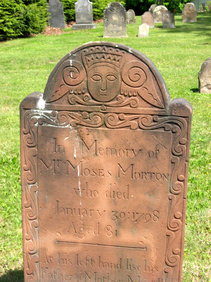
Do you wonder if your ancestors are buried in Hatfield’s oldest cemetery? Are you curious about 18th and 19th century epitaphs? Now you can find out without leaving your chair by searching the Microsoft Excel file linked below. These records were collected by an earlier incarnation of the Hatfield Historical Society in 1899.

The Hill Cemetery (at the corner of Elm and Prospect Sts., behind the American Legion) is where Hatfield residents were buried up until 1850, at which time the satellite cemeteries around town were started. Hatfield had no stone cutters until about 1720, so most grave markers before then were made from wood and did not survive.

This transcription was done by museum volunteer Max Krause, with help last summer from Smith Academy (’12) museum assistant Katie Keating. Thanks Max and Katie! Click here:

1899 Hill Cemetery gravestones

The following link – which comes to us via Max’s friend Gina Martel – is fabulous if you’re into old gravestones – or even if you’re not. The Farber Gravestone Collection, housed at The American Antiquarian Society in Worcester and digitized here, documents the sculpture on more than 9,000 gravestones, most of which were made prior to 1800. The 40 stark black-and-white photos from Hatfield’s Hill Cemetery are works of art in themselves. The listings that accompany the images give the carver, if known, as well as the name of deceased and death year, stone material and type of carving. Note the oldest Hatfield stones (1724-1728) carved by Joseph Nash, including one for little Mary Nash, who died “AGD NEAR 4 YEAR.” Another stone records the death of 19-year-old Aaron Goodrich, Jr., who died by the bite of a mad dog. Take a look; they are fascinating!
 
Farber Collection: Hatfield's Hill Cemetery

Martel also notes the Greenfield, MA-based Association for Gravestone Studies (AGS), an international organization dedicated to the study and preservation of gravestones of all periods and styles. AGS sponsors conferences, workshops and exhibits, and publishes an annual journal and a quarterly bulletin. A great resource to have in our own backyard.

And finally, here are some independent online sources for photos of Hill Cemetery gravestones. Thanks Beth and Rusty for sharing these images:

Shot by Ohio-based Beth Santore, a self-proclaimed grave addict:
http://www.graveaddiction.com/hillhf.html

Shot in 2004 by naturalist/historian Rusty Clark:
http://www.flickr.com/photos/23206546@N04/sets/72157619510335402/


    If you like this blog, subscribe!
    If you'd like to be sent a link each time a new entry is posted (which is periodically), please send an email with the subject line SUBSCRIBE to
    hatfieldhistoricalsociety
    @gmail.com

    Curator's musings...

    As the curator of a small town Historical Society museum, I wonder a great many things. Am I alone in these thoughts that come to me while driving, or exercising, or falling asleep at night? Is it unusual to be constructing displays and writing copy in one's head for an enlarged museum space that does not, as yet, exist?

    If you're wondering about the blog title, "bird by bird," see my First Post for an explanation! Click HERE to read it.

    When I'm not thinking about our museum or rehousing artifacts with my fellow museum committee members, I'm working with our exhibit committee to plan physical or virtual exhibits, and working with our board to help fundraise.

    I invite your comments and reactions.

    --Kathie Gow,
    former curator, 2010-2021


    Categories

    All
    18th Century
    19th Century
    Churches & Religion
    Collections Mgt.
    Conservation/preservation
    Death & Dying
    First Post
    Genealogy
    Graveyards
    Inventory Project
    Local Historical Society Issues
    Mass Militia
    Medical Care In Hatfield
    Moving The Museum
    Old Photos
    Oral History
    Other Museums
    Polish Immigration
    Provenance
    Slavery
    Smith Academy
    Storytelling
    Technology
    Tercentenary
    Textiles
    Wars & Rebellions

    Archives

    September 2023
    September 2022
    May 2022
    August 2021
    June 2021
    March 2021
    October 2020
    September 2020
    August 2020
    July 2020
    November 2019
    June 2019
    May 2019
    March 2019
    December 2018
    September 2018
    April 2017
    February 2017
    August 2016
    February 2016
    January 2016
    November 2015
    October 2015
    September 2015
    April 2015
    March 2015
    February 2015
    January 2015
    November 2014
    June 2014
    March 2014
    January 2014
    December 2013
    August 2013
    July 2013
    May 2013
    March 2013
    February 2013
    January 2013
    November 2012
    September 2012
    April 2012
    March 2012
    November 2011
    September 2011
    June 2011
    May 2011
    April 2011
    March 2011
    February 2011
    January 2011
    December 2010

Proudly powered by Weebly
Photo from Cea.