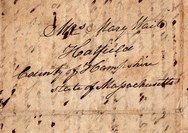
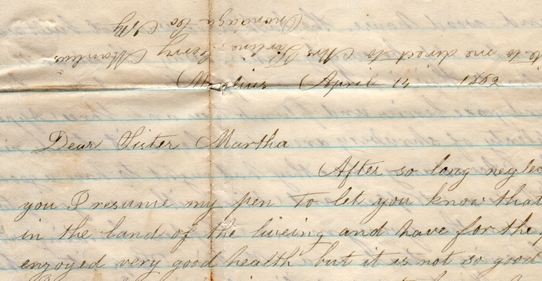
 Letter to Hatfield, Mass., dated 4/14/1862
 Guest Blog Post by Wayne Schlegel
We’ve come across a letter in the Hatfield Historical Museum written in 1862 that sheds some light on the life of older single women in the middle of the 19th century. (You can read its transcription HERE.) It was posted from Manlius, New York, an area opened up after the Revolutionary War, when a minimum of 100 acres was given to all enlisted men as a reward for their service (known as the Military Tract of Central New York). It was developed further by the opening of the Erie Canal. Manlius apparently attracted Hatfield, MA, resident Euroclydon Gerry, who moved there and married a local woman, Paulina Avery.
Writing to her Hatfield sister-in-law Martha Gerry, Paulina speaks of the difficulties of a 60-year old widow trying to keep afloat financially and spiritually. Widowed for 12 years, she finds herself burdened by the day-to-day job of just getting by. As she relates, “I cannot furnish but a small part [of my house] as I divided my things with my children keeping but two beds and I have but one of them.”
To make ends meet, she is forced to take in three borders. She is plagued by buyer’s remorse at having bought a house “larger than I need but it is the cheapest place that was for sale in the place and I was foolish enough to buy it at six hundred dollars.” She continues to beat herself up over the $100 it took to furnish the place as “it looks so foolish to me now that it almost upsets my mind and makes me very unhappy indeed.” She seems so unsure of herself, in fact, that she chooses not to tell relatives that she has bought the house and is determined to “sell it as soon as I can turn it well and not loose [sic] any thing “ as “it seams [sic] as if will make me to [sic] much care.”
We’ve come across a letter in the Hatfield Historical Museum written in 1862 that sheds some light on the life of older single women in the middle of the 19th century. (You can read its transcription HERE.) It was posted from Manlius, New York, an area opened up after the Revolutionary War, when a minimum of 100 acres was given to all enlisted men as a reward for their service (known as the Military Tract of Central New York). It was developed further by the opening of the Erie Canal. Manlius apparently attracted Hatfield, MA, resident Euroclydon Gerry, who moved there and married a local woman, Paulina Avery.
Writing to her Hatfield sister-in-law Martha Gerry, Paulina speaks of the difficulties of a 60-year old widow trying to keep afloat financially and spiritually. Widowed for 12 years, she finds herself burdened by the day-to-day job of just getting by. As she relates, “I cannot furnish but a small part [of my house] as I divided my things with my children keeping but two beds and I have but one of them.”
To make ends meet, she is forced to take in three borders. She is plagued by buyer’s remorse at having bought a house “larger than I need but it is the cheapest place that was for sale in the place and I was foolish enough to buy it at six hundred dollars.” She continues to beat herself up over the $100 it took to furnish the place as “it looks so foolish to me now that it almost upsets my mind and makes me very unhappy indeed.” She seems so unsure of herself, in fact, that she chooses not to tell relatives that she has bought the house and is determined to “sell it as soon as I can turn it well and not loose [sic] any thing “ as “it seams [sic] as if will make me to [sic] much care.”

Flirtation with spiritualism
The letter also shows Paulina’s flirtation with spiritualism, a movement which originated in upstate New York and attracted overwhelmingly female adherents. She writes of how a medium helped her contact the spirit of Martha’s departed sister Lucretia, who had died in 1851, and now reported that her “Spiritual home was a pleasant one” but less so than if she had “understood the phylosephy [sic] of Spiritualism while on earth.” We do not know if Paulina suspected a business pitch in the last remark, but she ends her letter unconverted.
Interestingly enough, the great political affairs of the nation (the Civil War, for example) are not mentioned. What remains is an intimate letter focusing on family matters tempered with some rudimentary speculations on the larger issues of life and death.
Wayne Schlegel, in addition to being a volunteer for the Hatfield Historical Museum, has been a teacher for the last 40 years, both in English and ESL, in the United States as well as in China, Japan, Qatar and Myanmar. He lives with his wife Leslie (also a teacher) in a historic house in Hatfield Center.
The letter also shows Paulina’s flirtation with spiritualism, a movement which originated in upstate New York and attracted overwhelmingly female adherents. She writes of how a medium helped her contact the spirit of Martha’s departed sister Lucretia, who had died in 1851, and now reported that her “Spiritual home was a pleasant one” but less so than if she had “understood the phylosephy [sic] of Spiritualism while on earth.” We do not know if Paulina suspected a business pitch in the last remark, but she ends her letter unconverted.
Interestingly enough, the great political affairs of the nation (the Civil War, for example) are not mentioned. What remains is an intimate letter focusing on family matters tempered with some rudimentary speculations on the larger issues of life and death.
Wayne Schlegel, in addition to being a volunteer for the Hatfield Historical Museum, has been a teacher for the last 40 years, both in English and ESL, in the United States as well as in China, Japan, Qatar and Myanmar. He lives with his wife Leslie (also a teacher) in a historic house in Hatfield Center.