Check us out on social media
hatfield historical society
  • Home
  • Events
    • Visitors and Workers
  • Collections
    • Foxfire Reports
    • Audio Stories
    • Profiles
  • Resources
    • Transciptions
    • Genealogy
  • Partners
  • Volunteers
  • Blog
  • Contact Us
    • Contact Us
    • Directions
    • Museum Shop
  • DONATE / JOIN
    • Membership
    • Donations
  • Farm Museum CPA
  • Link Page

Mystery #1: Militia shoulder belt plate

9/17/2012

 
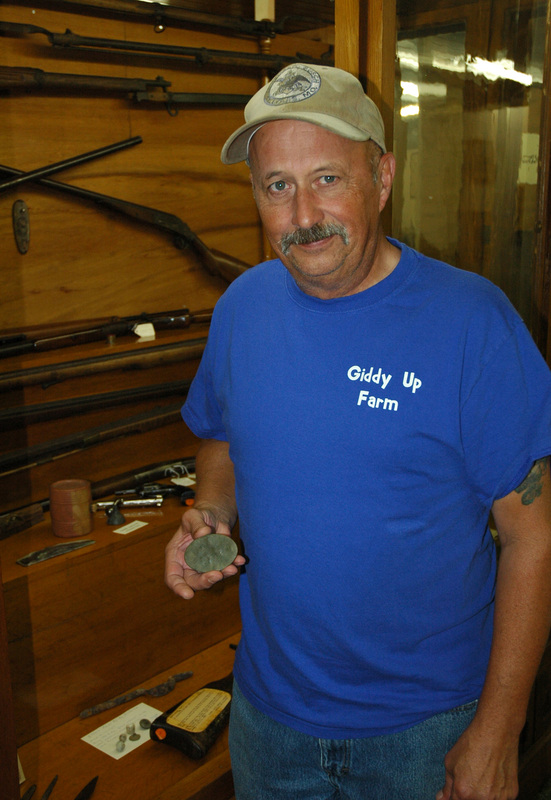
PictureAlan Schwartz with his Hatfield militia find.
We’ve had a few mysteries lately, and I’ll tell you about one of them today. Last week in the museum, a Westfield gentleman who’d been metal detecting in Hatfield (with permission from the landowner, of course), had found a treasure – a militia shoulder belt plate. The date estimate he’d gotten placed the brass plate at between 1790 and 1810. The back of the plate showed three of the four clips left to attach to the belt, and the front had markings across the face that looked like a fancy script name. Though hard to make out, friends helping him with the transcription had come up with a possible “John H………...”

Given the dates, we went looking for “John H.’s” in the online listing of headstone transcriptions from 1899 from the Hill cemetery, Hatfield’s oldest cemetery. The name did not look like John Hubbard, but looked like it could be one of the two John Hastings listed – one who died in 1845 at age 80 and the other who died in 1811 at age 73. Our visitor was happy to have a name to explore and we were happy to get to see (and share) this 200+-year-old artifact of militia garb.

Of course the mystery of the shoulder belt plate’s owner was only the first mystery. Ensuing mysteries for me included what role the local militia played, as opposed to the military, how long the militia were around, and how their uniforms, insignia and accessories differed from official military ones. Here’s an extremely informative ebook I found that answered a lot of my questions, American Military Insignia (1800-1851), by J. Duncan Campbell and Edgar M. Howell, the Smithsonian Institution, Washington, D.C., 1963. Check out what the authors say about the “volunteer” or “independent” Militia companies. Fascinating!
Dreaming of an airy courtyard...

9/1/2012

 
Picture
You might think that museum preservation work all takes place inside under artificial lights, wearing white cotton gloves and maybe a headband magnifier. It’s a nice thought. In our overcrowded museum, the surface of the so-called “work table” has not even been seen for, oh… I’m guessing five to seven years? It was like that when I arrived several years ago, and there have been too many other pressing tasks for it to rise to the top of the list yet. But, I diverge.

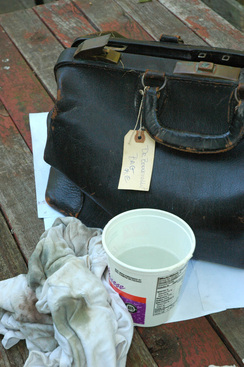
A few days ago I actually got to do some preservation work outside in the fresh air. I was cleaning dirt and mold off a mid-20th century (or older) leather doctor’s bag with mild soap and water. The bag, recently donated, has a tag attached that says it belonged to Dr. Bonneville, one of Hatfield's in-town doctors for decades. It cleaned up great, and I’ve been airing it out outside on dry days since then, trying to get rid of the smell of mold.

While working, I was thinking, you can’t really do this inside. Even next to a large window and a fan blowing out, how do most museums handle this sort of work? Or do they never accept artifacts that come to them with mold? What if it’s a historic piece that you really want? When I first brought the Dr. Bonneville bag home –he was a WWI army doctor who lived on Main St. next to the Town Hall, and was one of the town’s two beloved in-town doctors for years and years—my husband told me he didn’t want the bag in the house for the same reasons I didn’t want it in the museum. (I didn’t want to contaminate other items, or be breathing in the mold spores.) Until I could clean it, he made me put it in a bag in the back of my car. After cleaning, though, it was much better, and it’s been allowed to come into the mudroom at night, and sit outside under a little roof during the day.

What we really need in our museum, I thought, as I slowly worked my way across the bag’s surface, inside and out, is a little courtyard. A space protected from the wind and rain with room for a tall, sturdy lab table. It would open off the museum workroom, or maybe off the hallway, and have some benches and shelves available in a secure holding place. And a sink. Oh yes, a sink.

Well, I’ve got the lab tables, donated a year or two ago by Smith Academy, our local high school. Now I just need the courtyard, the hallway, and the sink. Oh, yes, and the larger, climate-controlled museum space to go with it. Come to think of it, we'll get most of that when the museum moves to the second floor of the Town Hall, after the elevator is installed. An open-air, second-floor courtyard will be tough, though. Hey, a girl can dream.

Many thanks to the donor of Dr. Bonneville's bag, Joe Pelis of Hatfield, who purchased it at a yard sale on School St. in Hatfield in the mid- to late 1990s. It will look great in an exhbit on Hatfield doctors and nurses we hope to put together in the next year or two. If you have other artifacts to donate that might go along with this, please give me a call or send me an email.


    If you like this blog, subscribe!
    If you'd like to be sent a link each time a new entry is posted (which is periodically), please send an email with the subject line SUBSCRIBE to
    hatfieldhistoricalsociety
    @gmail.com

    Curator's musings...

    As the curator of a small town Historical Society museum, I wonder a great many things. Am I alone in these thoughts that come to me while driving, or exercising, or falling asleep at night? Is it unusual to be constructing displays and writing copy in one's head for an enlarged museum space that does not, as yet, exist?

    If you're wondering about the blog title, "bird by bird," see my First Post for an explanation! Click HERE to read it.

    When I'm not thinking about our museum or rehousing artifacts with my fellow museum committee members, I'm working with our exhibit committee to plan physical or virtual exhibits, and working with our board to help fundraise.

    I invite your comments and reactions.

    --Kathie Gow,
    former curator, 2010-2021


    Categories

    All
    18th Century
    19th Century
    Churches & Religion
    Collections Mgt.
    Conservation/preservation
    Death & Dying
    First Post
    Genealogy
    Graveyards
    Inventory Project
    Local Historical Society Issues
    Mass Militia
    Medical Care In Hatfield
    Moving The Museum
    Old Photos
    Oral History
    Other Museums
    Polish Immigration
    Provenance
    Slavery
    Smith Academy
    Storytelling
    Technology
    Tercentenary
    Textiles
    Wars & Rebellions

    Archives

    September 2023
    September 2022
    May 2022
    August 2021
    June 2021
    March 2021
    October 2020
    September 2020
    August 2020
    July 2020
    November 2019
    June 2019
    May 2019
    March 2019
    December 2018
    September 2018
    April 2017
    February 2017
    August 2016
    February 2016
    January 2016
    November 2015
    October 2015
    September 2015
    April 2015
    March 2015
    February 2015
    January 2015
    November 2014
    June 2014
    March 2014
    January 2014
    December 2013
    August 2013
    July 2013
    May 2013
    March 2013
    February 2013
    January 2013
    November 2012
    September 2012
    April 2012
    March 2012
    November 2011
    September 2011
    June 2011
    May 2011
    April 2011
    March 2011
    February 2011
    January 2011
    December 2010

Proudly powered by Weebly
Photo from Cea.