Check us out on social media
hatfield historical society
  • Home
  • Events
    • Visitors and Workers
  • Collections
    • Foxfire Reports
    • Audio Stories
    • Profiles
  • Resources
    • Transciptions
    • Genealogy
  • Partners
  • Volunteers
  • Blog
  • Contact Us
    • Contact Us
    • Directions
    • Museum Shop
  • DONATE / JOIN
    • Membership
    • Donations
  • Farm Museum CPA
  • Link Page

Real or repro? What to display and what to “fix”?

3/6/2019

0 Comments

 
Picture
I just read an article from The Washington Post Magazine (Feb. 27, 2019, thanks AASLH), titled “The Imitation Game: Some of the most beloved objects in Washington museums are not as authentic as visitors might assume.”

This article struck a nerve because of two discussions I had this week regarding OUR museum.

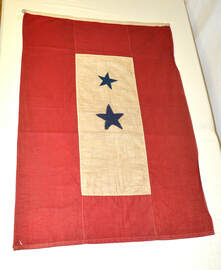
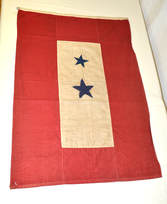
The first was with fellow staff for our upcoming World War I exhibit on whether or not to hang our World War I service flag (or blue star flag). Folks would hang the flag in their window to let others know they had family members serving in the war (see earlier post about service flags HERE). The flag has some wear lines and holes near the bottom, and it was our textile specialist’s concern that hanging for a year or more could risk expanding those holes.

Instead, perhaps we mount the flag on a slant board covered with archival fabric, as we’re doing for another more fragile textile in the exhibit (Marion Billings' Victory Dance dress), BUT, we don’t have a safe place to position a slant board where we need it.


We could photograph the flag and pay to have it reproduced poster size and mounted on foamcore -- and hang that. That would still give us the deep shot of color amidst the army green and dark metal helmets and show a copy of our local flag, not just an image pulled from the Internet.

Or maybe we could buy a repro flag from ebay for not too much money, suggested Meg Baker, our textile specialist, and not worry about light or hands touching it.

Yet, here's the thing: we have the ACTUAL flag that was displayed in a window by a Hatfield family, the Bardwells, representing their sons Homer and Curtis serving in the war. If this flag is not displayed now, for our WWI exhibit, then when? This is it’s time in the sun!

OK, bad metaphor, especially since one side is quite faded from prior light damage -- probably from hanging in the Bardwell’s window. For the record, we have UV-blocking tubes on all our fluorescent lights and no direct sunlight would reach the flag.


These are the sorts of discussions that go on all the time when making museum display decisions -- balancing the value of showing the public authentic artifacts against the responsibility to preserve those artifact for the future.

Here’s what we decided -- at least for now. Hang the real flag on archival fabric for the opening on Memorial Day Weekend and through July 4. But for the remainder of the exhibit, replace it with a poster-sized reproduction on foamcore, noting why we made that decision.
Picture
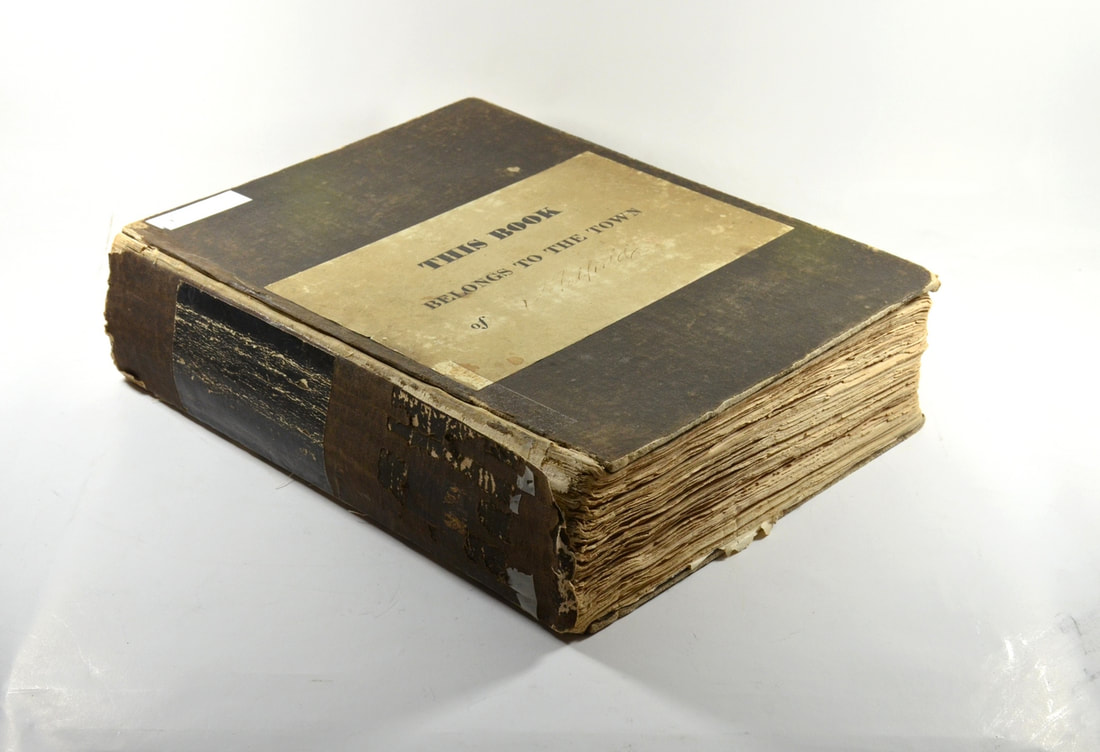
That was the first discussion. The 2nd one, via email, was with local bookbinder John Nove, who is doing repair work on a group of our museum books. In this case, he proposed repairing a tear and making a pocket to hold the somewhat brittle misfolded map attached to the back of Edward Hitchcock’s 1841 Final Report on the Geology of Massachusetts in Four Parts. We decided to do that because it would better preserve the map and make it possible to unfold and view without hurting it further.

He also asked if he should remove the library pocket and card (with no entries), not on the last page, but 2 pages inside the back cover, especially since the book was marked elsewhere as “Reference, not to be taken out.”


Once confirming the library pocket was not hurting the book or the map, I asked him to leave the library pocket alone, as it helps tell the story of this particular book -- however confusing a story that may be.

Artifacts often mirror life in that way -- confusing and messy. But sometimes their circuitous journeys are also what draw us in.
0 Comments

Public grief and the blue star flag

9/19/2018

0 Comments

 
PictureBardwell WWI service flag
Guest post by Meguey Baker
Collections Assistant, Hatfield Historical Museum


The idea of social grief, that we are or could be united by loss, was an important part of the makeup of the 20th century. Yesterday in the Hatfield Historical Museum we inventoried the flags and banners from our textile collection. There are many, but the one that stopped me was this one: the World War I Service flag for Homer Bardwell and Curtis Bardwell (below).

These flags were used to signify the homes of people in the military. A blue star was for a person serving, a gold star was for a person who had died in service, a gold cross for a person injured in service. Some homes had one star, others had several. All of them helped those passing by to understand that this family was thinking of someone far away, possibly in harm’s way. This helped form a community and support for families if anything in the news was cause for alarm. If a family had a blue star and then it was replaced with a gold star, everyone knew what had happened. Everyone could be extra considerate and compassionate with the grieving family.

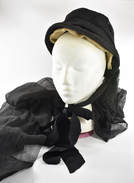
Picture19th century mourning wear
Also recently in the museum, we inventoried all of the hats, including an entire box of black mourning wear. Black hats, black bonnets with long black veils, black ribbon collars, dull black bands and black net shawls. There was a whole system of mourning wear, from deepest black through dark purple to lavender to gray and white. Colors would return as you felt able or after commonly accepted lengths of time.  Whole industries grew up around this, with whole methods of fabric production. Mourning wear served the same purpose for grieving individuals that blue star and gold star flags served for families. Beyond the message to people passing by the house, this mourning wear alerted everyone you interacted with throughout your day that you were in grief, and to perhaps be understanding if you took a little more time to do a simple task, or suddenly teared up for no clear reason.

PictureRuth Withun Lord, died 2007
I miss this. A dozen years ago, my family went through a long hard period of loss. In 18 months, I lost three grandparents (including my grandmother at left), my father-in-law, and two brothers-in-law. I remember standing at the counter at the gas station, trying to complete the exchange, and wishing so very much that I could be wearing a black mourning band or veil so that people would know, without me having to tell them, that I was bearing up under the pain of loss, and they might be more patient with me. I wanted to see other people around town wearing black or sober clothes, to have some sense of not being alone in the depths of my grief. Even if I did not know them, to have seen other people walking around with clear signifiers of loss and grief would have been a tremendous comfort.

We want comforting when we are grieving, and we want to know we are not alone when we are feeling so bereft. During many of our nation’s wars, the names of the injured and dead were published in the local papers, and buildings and people were visibly marked by loss. We have in our collective memory black-draped hearses and Jackie Kennedy in a black hat and sheer black veil, flag-draped coffins and candle-light vigils. Maybe sometime we will again have a way for people to convey their personal grief with the same simple wordless dignity that a WWI Service flag or a black armband gave to those in decades past. For now, let us remember that no matter what people are wearing, some of those we see each day are suffering great loss and none of us are or need to be alone in our sorrow.

Author

Meguey Baker studied early American textile history and material culture at Hampshire College. She is a member of the Mohawk Trail Quilt Guild, on the board of the Historical Society of Greenfield, and does textile repair and conservation for private clients.

0 Comments

Extraordinary clues in ordinary places

11/16/2015

0 Comments

 
Guest Post by Meguey Baker, Collections Assistant at the Hatfield Historical Museum

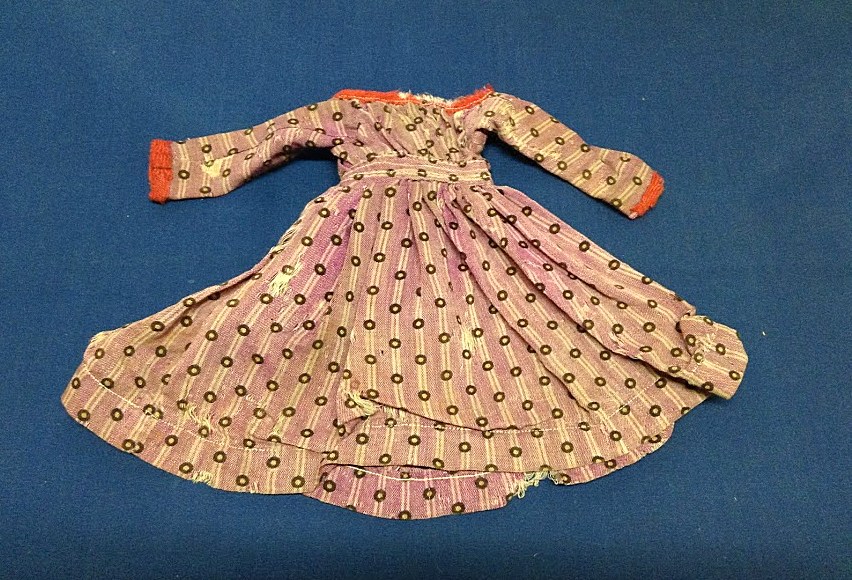
There is always something special about children’s toys that have survived down through time. Not only do they speak to well-loved playthings and the sentimentality of the little owner and the family that preserved them, but there is much to be learned from the articles themselves. This doll’s dress holds a wealth of information, even in its worn state.
Picture
Click for larger image
This is a very practical doll’s dress circa 1860. It was used, taken on and off, possibly washed by the little child to whom it belonged. The threadbare fabric and the worn red edging suggest this was a teaching toy such as little girls and boys have always loved and used to practice sewing, dressing, laundering, and other parenting and housekeeping skills. There are certainly examples of dolls and doll clothes from  this era that are pristine, unused and definitely “not for children" -- this is the opposite, which makes its preservation more remarkable.

The first thing that is noteworthy in seeing this dress is the fabric. The shade is dramatic and the style is expressive of the day, and we can use the two to make an educated estimate of when the dress was made. An innovation in dye technology created a colorfast purple or mauve dye in 1859; before that time, purples were often unfixed -- or fugitive -- and faded out nearly completely by our current day, especially for something as well used as this dress. So, we know this was made post-1859. The style of the dress also provides dating details. The sleeves are fully lined with tan cotton muslin, just as the child’s sleeves may well have been. The bodice, waistband, and very full skirt all mirror mid-1800s fashions.

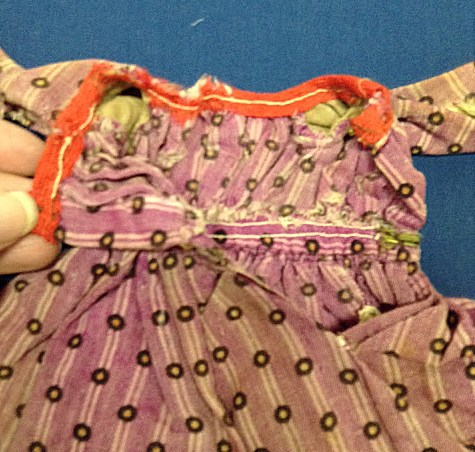
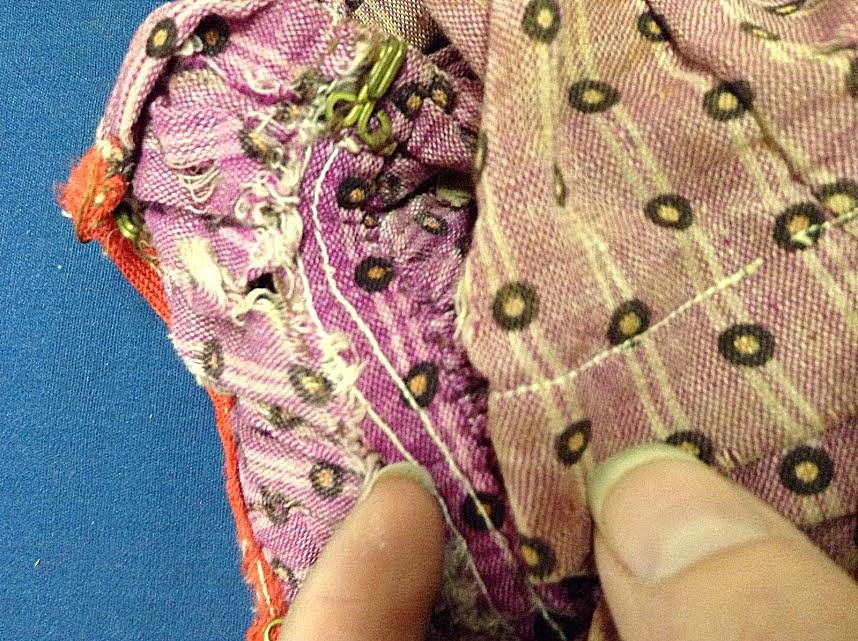
Here is where we begin to get clues as to the seamstress: the red wool tape neckband and trim. If this were a grown woman making beautiful doll clothes for her child, we might expect a bit of black ribbon, perhaps a scrap of simple lace. That red wool is whimsical and indifferent to social ideas of what colors go with what prints. Between that and examining the seams, I feel very comfortable saying that this dress was made by a child, or at least by a less experienced seamstress. The hand stitching is serviceable but not fine or well-practiced, and we have in company with this dress crisp white over skirts that show a finer quality of work. To me, this reads absolutely as scraps of a fancy new purple cloth handed over to a child so she might make a dress for her doll.

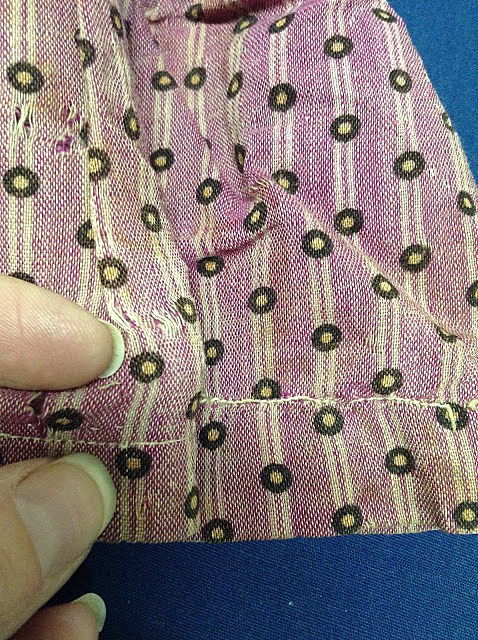
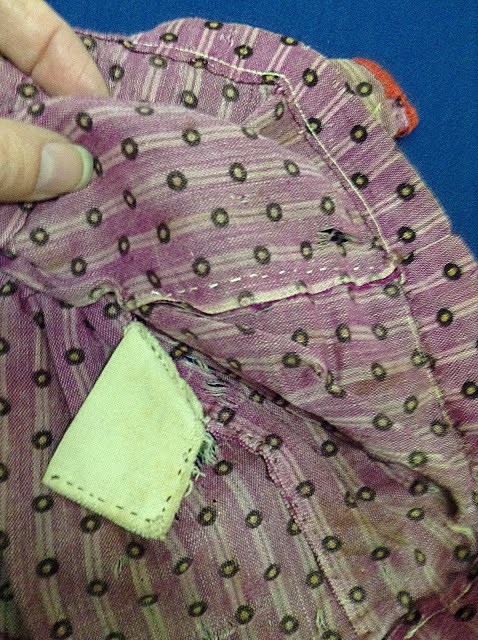
There is even a nice blend of skills, as the construction seams are hand sewn (see photos above) and the hem is sewn by machine -- sewing machines being a recent arrival in the home following Elias Howe’s 1846 invention in nearby Cambridge, MA. By 1860, this technology was available to the home seamstress, but it was still a very new thing, not in every home, and certainly used under supervision. This explains the machine stitching on the hem, where there are few consequences if the seam goes a little astray.

PicturePocket! (click for larger image)
The last and perhaps most charming feature of this dress is the transitional pocket. Pockets are no longer always a separate item of clothing in the 1860s, tied around the waist beneath the dress, alongside the hoop skirts and petticoats. The seamstress gave her dolly a pocket set into the side seam. This is a complex process for a child, requiring multiple steps and a three-dimensional understanding of the fabric. It is also a beautiful practicality, that she wanted her doll to have a modern pocket, and she was imagining what her doll might carry with her.

Nonetheless, it would be easy to overlook, and it is a reminder to all who are interested in dating or learning more about objects to look inside and under and behind as well as straight on.


From a child’s plaything, we can not only make informed decisions about the date and techniques of creation, but also peek into the past domestic scene in which it was made. Such a lot of information packed into such an ordinary thing!

Cool links:
--
An article on children’s toys in 1860
--A revolution in permanent purple dye
--A history of sewing machines

Meguey Baker studied early American textile history and material culture at Hampshire College. She is a member of the Mohawk Trail Quilt Guild, a volunteer textile conservation specialist at Memorial Hall in Deerfield, and does textile repair and conservation for private clients.

0 Comments

Victorian mystery in first week on the job

9/21/2015

0 Comments

 
The following guest post is written by Meguey Baker, our new Collections Assistant working on the Collections Management & Preservation Project for the Hatfield Historical Museum. This is our multi-year project to inventory and rehouse our collection in archival settings, funded by Hatfield's Community Preservation Act. Meg comes to us from Memorial Hall Museum in Deerfield, where she's done work over the last five years in historic textile preservation and conservation. She replaces prior Collections Assistant Hannah Zahn, responsible for transcribing our hand-written accessions register #2 so we can now search it electronically (thanks, Hannah!). Please welcome Meg and check out her post about how to search for something online when you don't know what it is.

PictureClick image for larger view
By Meguey Baker

One of the most delightful things about material culture and conservation work is the process of discovery. Every artifact is interesting for various reasons, and I love when I encounter something entirely new. I have seen a lot of different examples of decorative arts, but on my first day as the collections assistant at the Hatfield Historical Museum, I saw something I had never seen before. Curator Kathie Gow handed me a box of items to write up accession sheets for.  There were a few fans, a needlepoint piece, and what appeared to be a booklet of faded construction paper, fastened with a bow on one side.

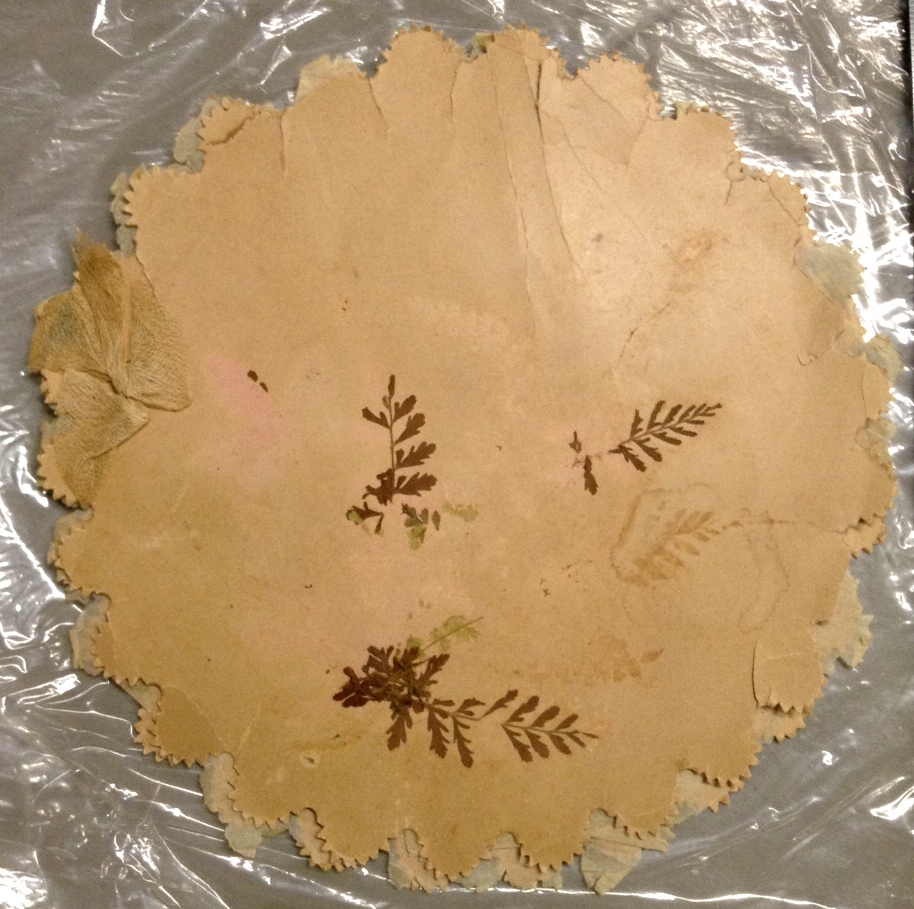
PictureWhat is it?
As soon as I opened the cover, however, I knew it was something special (click on image at left). The delicate pressed ferns and flowers were still crisp and bright, the fringed edge was shining golden, and the netting ground was fully intact. The whole thing sang "Victorian fancy work!" clear as a bell.
     When I went home that afternoon, I couldn't stop thinking about the wreaths and the golden fringe and the not-quite-geometric netting that supported the pressed plants. Thankfully, we now have modern technology as well as old books of fancy work ideas and directions. To the internet I went. My first search was for “Victorian pressed flowers.” My goodness there are a lot of folks making things in the Victorian style these days. Next search: “vintage Victorian pressed ferns” That brought me to Etsy, a marketplace for new and vintage crafts, where there was a very similar construction paper doily.
     This artifact looked so much like the one I'd seen earlier in the day I felt it must be the same technique, particularly in the close-up of the not-quite-geometric netting. How exciting! And a new lead, with new search terms -- the caption mentions Jamaica, the U.K., and fundraising in the 1870s.
     My next search, “1870 pressed ferns Jamaica,” took me to the last step on this discovery quest: A PDF of a paper on Jamaican lace-bark, which has an inner bark that can be stretched and expanded to make a sturdy, flexible natural netting. The article even shows a picture of a wreath like ours and identifies the golden outer fringe as the seed hairs of French cotton, Calotropis procera – which is basically a giant milkweed. The link is absolutely clear, and there remains no doubt in my mind that what we have in Hatfield is an authentic 1870s Jamaican fern doily. This allows us to include a date on the record for this piece, and to understand more about how it may have wound up in Hatfield – these artifacts were made and sold either as souvenirs or as fundraising items to support mission work in Jamaica.

In writing this up and recreating my searches, I came across a few other interesting sites with more information on these beautiful handcrafts:

Jamaican Fern Doyleys
Fern Gully Jamaica

I wonder what discoveries my second week will bring?

0 Comments
    If you like this blog, subscribe!
    If you'd like to be sent a link each time a new entry is posted (which is periodically), please send an email with the subject line SUBSCRIBE to
    hatfieldhistoricalsociety
    @gmail.com

    Curator's musings...

    As the curator of a small town Historical Society museum, I wonder a great many things. Am I alone in these thoughts that come to me while driving, or exercising, or falling asleep at night? Is it unusual to be constructing displays and writing copy in one's head for an enlarged museum space that does not, as yet, exist?

    If you're wondering about the blog title, "bird by bird," see my First Post for an explanation! Click HERE to read it.

    When I'm not thinking about our museum or rehousing artifacts with my fellow museum committee members, I'm working with our exhibit committee to plan physical or virtual exhibits, and working with our board to help fundraise.

    I invite your comments and reactions.

    --Kathie Gow,
    former curator, 2010-2021


    Categories

    All
    18th Century
    19th Century
    Churches & Religion
    Collections Mgt.
    Conservation/preservation
    Death & Dying
    First Post
    Genealogy
    Graveyards
    Inventory Project
    Local Historical Society Issues
    Mass Militia
    Medical Care In Hatfield
    Moving The Museum
    Old Photos
    Oral History
    Other Museums
    Polish Immigration
    Provenance
    Slavery
    Smith Academy
    Storytelling
    Technology
    Tercentenary
    Textiles
    Wars & Rebellions

    Archives

    September 2023
    September 2022
    May 2022
    August 2021
    June 2021
    March 2021
    October 2020
    September 2020
    August 2020
    July 2020
    November 2019
    June 2019
    May 2019
    March 2019
    December 2018
    September 2018
    April 2017
    February 2017
    August 2016
    February 2016
    January 2016
    November 2015
    October 2015
    September 2015
    April 2015
    March 2015
    February 2015
    January 2015
    November 2014
    June 2014
    March 2014
    January 2014
    December 2013
    August 2013
    July 2013
    May 2013
    March 2013
    February 2013
    January 2013
    November 2012
    September 2012
    April 2012
    March 2012
    November 2011
    September 2011
    June 2011
    May 2011
    April 2011
    March 2011
    February 2011
    January 2011
    December 2010

Proudly powered by Weebly
Photo from Cea.