I’m guessing you have a few old family photos with no names written on the back and no one left to identify them, whether in your family’s stash of photos or in your museum’s Collection. Or maybe you have a lot. That would be true for me on both counts. But help is on the way.
Last Thursday I participated in the last of a five-class webinar called “Caring for Photographs,” hosted by Heritage Preservation (along with AASLH, IMLS and Learning Times). It was presented by Debra Hess Norris, chair of the Art Conservation Department at the University of Delaware, and a professor of Photograph Conservation. It was a great course, with all manner of practical advice about caring for and identifying old photos and negatives. If you’re interested, you will soon be able to watch any of the five sessions online and/or access the many wonderful links and resources for each one, just by going to the “Connecting to Collections” website and clicking on one of the webinar recordings.
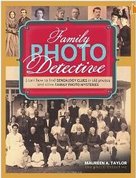
That same evening I also started reading the book Family Photo Detective by Maureen A. Taylor, published in February, and immediately got pulled in. All I want to do now is read it!
Last Thursday I participated in the last of a five-class webinar called “Caring for Photographs,” hosted by Heritage Preservation (along with AASLH, IMLS and Learning Times). It was presented by Debra Hess Norris, chair of the Art Conservation Department at the University of Delaware, and a professor of Photograph Conservation. It was a great course, with all manner of practical advice about caring for and identifying old photos and negatives. If you’re interested, you will soon be able to watch any of the five sessions online and/or access the many wonderful links and resources for each one, just by going to the “Connecting to Collections” website and clicking on one of the webinar recordings.
That same evening I also started reading the book Family Photo Detective by Maureen A. Taylor, published in February, and immediately got pulled in. All I want to do now is read it!
And so it was, armed with my newfound knowledge from the webinar and a few chapters into the book, last Saturday at the Hatfield Historical Museum I was able to do some detective work of my own.
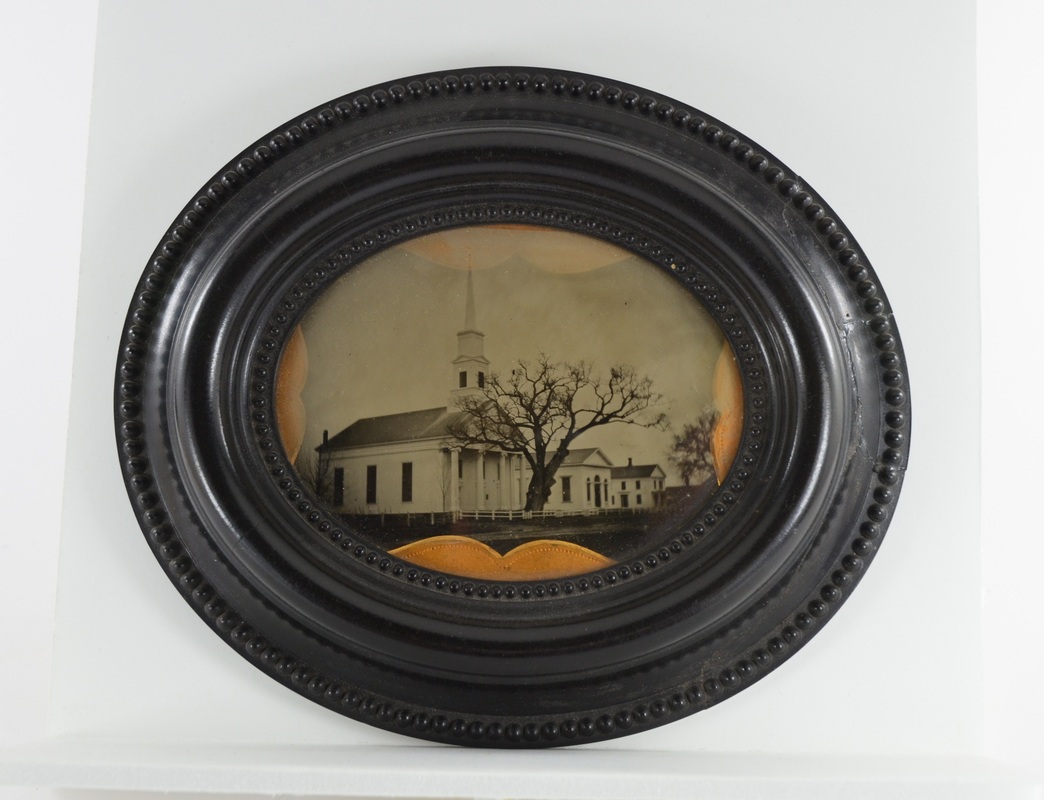
For our in-progress inventory of the Collection, we hoped to determine the age of this framed image of the Hatfield Congregational Church (built in 1849 and still serving its congregation!) and the old Town Hall next to it. (Click the image below for a larger picture.)
A note written on the back of the frame says the Town Hall burned in 1928, so I know it’s before that. But the first thing that strikes me about the photograph is that there is no clock on the tower above the bell. Since our inventory is currently working on paper-based artifacts, the church files are mostly organized and I’m able to pull out the folder of historical booklets from the Congregational Church. In the Manual of the Congregational Church, Hatfield, Mass., dated June 1918, I discover that the clock was installed in 1891, so I know it’s before that.
There is also a stamp on the back of the frame giving the photographer’s name, and the words “Artist” and “Ambrotype.” (Again, click the image below for a larger picture.)
For our in-progress inventory of the Collection, we hoped to determine the age of this framed image of the Hatfield Congregational Church (built in 1849 and still serving its congregation!) and the old Town Hall next to it. (Click the image below for a larger picture.)
A note written on the back of the frame says the Town Hall burned in 1928, so I know it’s before that. But the first thing that strikes me about the photograph is that there is no clock on the tower above the bell. Since our inventory is currently working on paper-based artifacts, the church files are mostly organized and I’m able to pull out the folder of historical booklets from the Congregational Church. In the Manual of the Congregational Church, Hatfield, Mass., dated June 1918, I discover that the clock was installed in 1891, so I know it’s before that.
There is also a stamp on the back of the frame giving the photographer’s name, and the words “Artist” and “Ambrotype.” (Again, click the image below for a larger picture.)
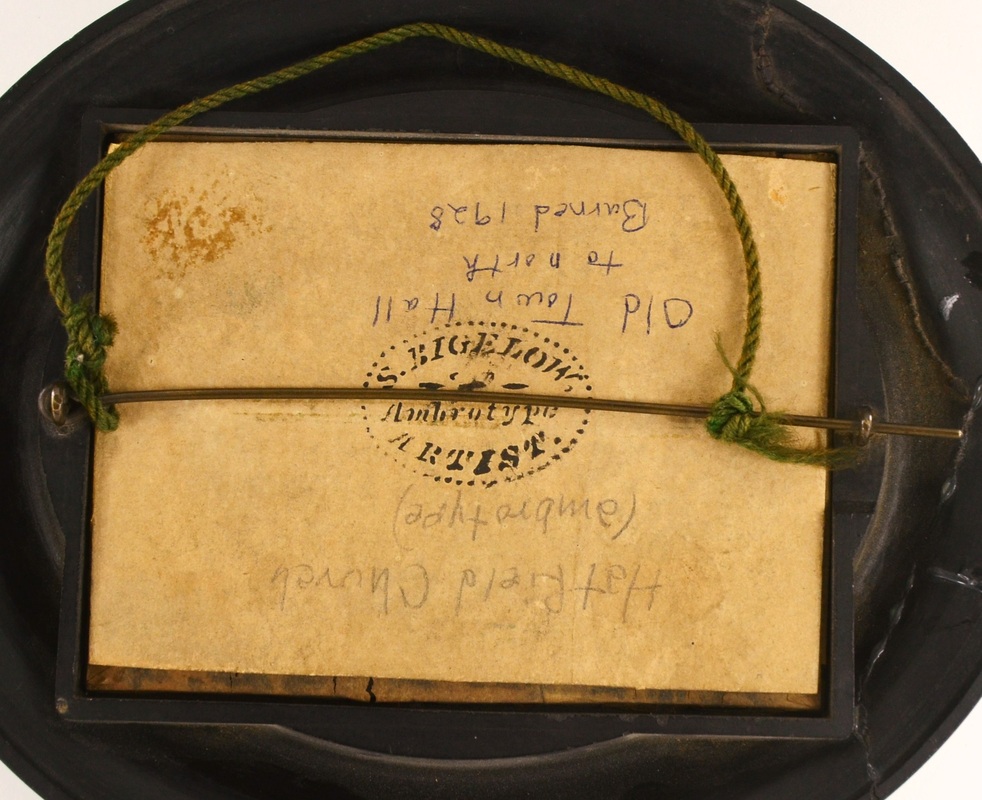 Reverse of framed ambrotype.
 From my webinar course and Maureen Taylor’s book, I’ve learned that ambrotypes (positive images on a sheet of glass) were produced between 1852/54 and 1880, so now I’ve narrowed the field to a span of less than 30 years. As I continue looking in the same Manual, I come upon the following:
“For many years an old elm, the largest tree in Hatfield, stood directly in front of the present church edifice and the tree remained standing in all its kingly beauty up to the year 1868.”
Great! That narrows it down to 1852-1868. Next I turn to the Internet to try to discover when S. Bigelow plied his trade. I don’t find much. What I do find is a blog post by “Sarah Beth” about a carte de visite by S. Bigelow, located in Collinsville, CT, and her research puts him there sometime between 1861 and 1869.
Ambrotypes and carte de visites (small photo portraits mounted on cards) were popular during the same time, so it doesn’t help narrow my search, but perhaps S. Bigelow was not doing enough business to pay rent for his “Photographic Rooms” over Polk’s drug store (see blog post above), and he hit the road, coming north through Hatfield. Do we have other ambrotypes or carte de visites in our collection by this photographer?
From the Family Photo Detective and the Internet, I learn that the U.S. government levied tax revenue stamps on all photographs from August 1864 to August 1866 to help pay for the war, and since there is no tax stamp, it was probably not taken and purchased during this time.
I could surmise further that since the church made several improvements in 1867, they might have been more inclined to record a picture of the church at that time. According to the booklet titled Two hundred fiftieth anniversary, Hatfield Church, 1920, printed by Press of Gazette Printing Company, a vestry was added to church in 1867, “at which time the organ loft was built and the present organ put in place.”
So that’s where I’ve stopped – at least for now. What I know for sure is that this ambrotype of the Hatfield church and town hall was made by S. Bigelow between 1852 and 1868. Though I’m still left with a 16-year window, I have to say I feel pretty satisfied, considering I now know the image is at least 145 years old!
If anyone out there has any additional info on S. Bigelow, ambrotype artist in the Connecticut River Valley in the 1860s, please let me know, and I’ll post any updates.
Think how fun it will be to do this for the rest of our Collection! We need more volunteers! (Or more hours in our inventory grant.) For now, I’m looking forward to reading Chapter 11 in the Family Photo Detectiveon on photograph albums, as we have at least several albums we think are from the late 1800s – with none of the photos ID-ed. But that is work and a post for another day.
“For many years an old elm, the largest tree in Hatfield, stood directly in front of the present church edifice and the tree remained standing in all its kingly beauty up to the year 1868.”
Great! That narrows it down to 1852-1868. Next I turn to the Internet to try to discover when S. Bigelow plied his trade. I don’t find much. What I do find is a blog post by “Sarah Beth” about a carte de visite by S. Bigelow, located in Collinsville, CT, and her research puts him there sometime between 1861 and 1869.
Ambrotypes and carte de visites (small photo portraits mounted on cards) were popular during the same time, so it doesn’t help narrow my search, but perhaps S. Bigelow was not doing enough business to pay rent for his “Photographic Rooms” over Polk’s drug store (see blog post above), and he hit the road, coming north through Hatfield. Do we have other ambrotypes or carte de visites in our collection by this photographer?
From the Family Photo Detective and the Internet, I learn that the U.S. government levied tax revenue stamps on all photographs from August 1864 to August 1866 to help pay for the war, and since there is no tax stamp, it was probably not taken and purchased during this time.
I could surmise further that since the church made several improvements in 1867, they might have been more inclined to record a picture of the church at that time. According to the booklet titled Two hundred fiftieth anniversary, Hatfield Church, 1920, printed by Press of Gazette Printing Company, a vestry was added to church in 1867, “at which time the organ loft was built and the present organ put in place.”
So that’s where I’ve stopped – at least for now. What I know for sure is that this ambrotype of the Hatfield church and town hall was made by S. Bigelow between 1852 and 1868. Though I’m still left with a 16-year window, I have to say I feel pretty satisfied, considering I now know the image is at least 145 years old!
If anyone out there has any additional info on S. Bigelow, ambrotype artist in the Connecticut River Valley in the 1860s, please let me know, and I’ll post any updates.
Think how fun it will be to do this for the rest of our Collection! We need more volunteers! (Or more hours in our inventory grant.) For now, I’m looking forward to reading Chapter 11 in the Family Photo Detectiveon on photograph albums, as we have at least several albums we think are from the late 1800s – with none of the photos ID-ed. But that is work and a post for another day.