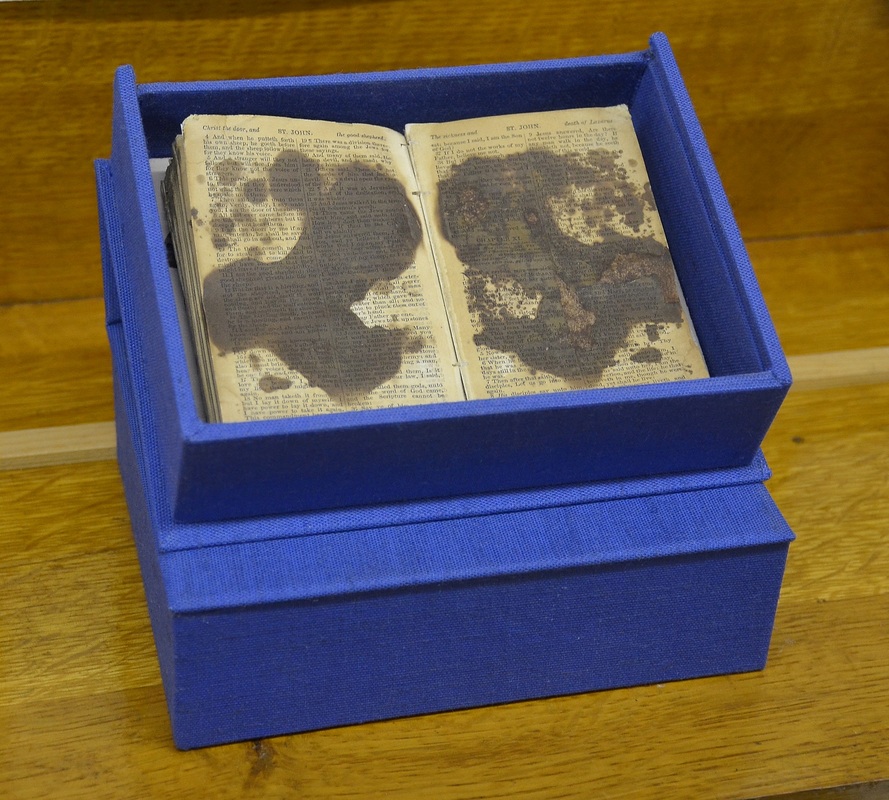
 Civil War Bible (click for larger image)
 It was three 5th and 6th grade girls and our town clerk who made my day last Tuesday, helping to answer the question: Why do we save items from our town’s history, anyway? Why not just send folks to the Internet, where they can read up on wars, migrations and how things used to be?
These girls often pop upstairs after school and ask if the museum is open – or if there are any jobs for them to do. I tell them, well, the museum is officially closed so we can work – with open boxes filling the tables and some of the aisles – but that they’re welcome to look around if they’re careful. They check out the WWII cigar thank you letters and the schoolchildren letters sent in 1911 to a sick classmate (Johnnie Winters). Then one of the girls (Grace, Rose or Lily) glances around the WWII exhibit case and asks if the blood-stained Bible is still on display. I tell her no, since the Civil War exhibit has been replaced, but, I could show it to them all the same.
I have to reach up high to get it, and carefully bring it down. Over at a clear table I show them the exquisite custom blue box made for the pocket 1863 New Testament by paper conservator and bookbinder Daniel Gehnrich. The box and repairs on the book were funded by the town’s Community Preservation Act. Prior to that, it had been wrapped in saran wrap, resting on a wire plate holder. I show them how the box doubles as a display stand so we don’t have to handle it, and where the supposed bullet hole used to be, amidst the blood-stained pages.
These girls often pop upstairs after school and ask if the museum is open – or if there are any jobs for them to do. I tell them, well, the museum is officially closed so we can work – with open boxes filling the tables and some of the aisles – but that they’re welcome to look around if they’re careful. They check out the WWII cigar thank you letters and the schoolchildren letters sent in 1911 to a sick classmate (Johnnie Winters). Then one of the girls (Grace, Rose or Lily) glances around the WWII exhibit case and asks if the blood-stained Bible is still on display. I tell her no, since the Civil War exhibit has been replaced, but, I could show it to them all the same.
I have to reach up high to get it, and carefully bring it down. Over at a clear table I show them the exquisite custom blue box made for the pocket 1863 New Testament by paper conservator and bookbinder Daniel Gehnrich. The box and repairs on the book were funded by the town’s Community Preservation Act. Prior to that, it had been wrapped in saran wrap, resting on a wire plate holder. I show them how the box doubles as a display stand so we don’t have to handle it, and where the supposed bullet hole used to be, amidst the blood-stained pages.
Together, we wonder how the blood got there, and what happened to the soldier. They read the label and see it was donated by a Dr. C.S. Hurlburt of Springfield, a dentist, who married Mary Wait Allis of Hatfield.
Sitting next to me on the table is a book I had gotten from the town clerk (Lydia Szych) earlier in the day, to add some numbers to our recently completed Mass Humanities-funded medical history grant, and it occurs to me these curious-minded girls might find the book as interesting as I did. I have them read me the title on the spine: Record of Dangerous Diseases, Town of Hatfield.
The book records all of the town’s infectious diseases between 1915 and 1944, including an outbreak of measles in 1918 (53 cases!) among schoolchildren and several hundred case of influenza in 1918-1919, resulting in at least 11 deaths. Coincidentally, Rose had just been looking at a book in the library downstairs that talked about the very same flu epidemic – and here was the Hatfield record of cases in our town.
Sitting next to me on the table is a book I had gotten from the town clerk (Lydia Szych) earlier in the day, to add some numbers to our recently completed Mass Humanities-funded medical history grant, and it occurs to me these curious-minded girls might find the book as interesting as I did. I have them read me the title on the spine: Record of Dangerous Diseases, Town of Hatfield.
The book records all of the town’s infectious diseases between 1915 and 1944, including an outbreak of measles in 1918 (53 cases!) among schoolchildren and several hundred case of influenza in 1918-1919, resulting in at least 11 deaths. Coincidentally, Rose had just been looking at a book in the library downstairs that talked about the very same flu epidemic – and here was the Hatfield record of cases in our town.


We note that a girl of 7 who lived on Bridge St. contracted mumps on the same day, Nov. 17, one hundred years earlier. Likewise, Grace notes that someone contracted influenza on her birthday in October, nearly 100 years ago. They all make sad noises upon seeing that two of the children who contracted whooping cough in Dec. 1915 and Jan. 1916 – a 1 year-old and a 2-1/2-mo.-old. – died (see center image above).
One of the girls’ phones rings, and it is getting late, so I tell them to come back another day. I hear them say to each other going down the stairs,“that was fun…” And I think, yes, that was fun, and it reminds me why we are here.
One of the girls’ phones rings, and it is getting late, so I tell them to come back another day. I hear them say to each other going down the stairs,“that was fun…” And I think, yes, that was fun, and it reminds me why we are here.