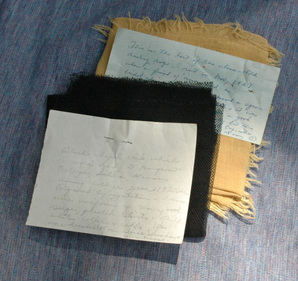
Like most things in life, it's how a thing is done that determines its value
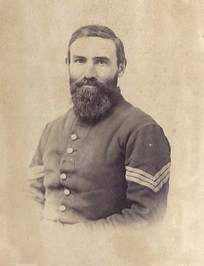 Sgt. Edwin Graves, 37th Mass. Reg., Co. F
 Two years ago, not long after my “In Praise of Provenance” post where I talked about the issues raised in Craig Childs’ book Finders Keepers: A Tale of Archaeological Plunder and Obsession, I got an email from a Virginia man who organizes Civil War relic hunting trips. He’d purchased a gold badge that had belonged to Hatfield Civil War soldier Sgt. Edwin Graves, of the 37th Massachusetts Regiment, Co. F, and he wondered if the Hatfield Historical Society might have any additional information on Graves.
Since I’d recently helped to organize local archaeologist Randy Daum’s presentation on his “Old Farms” archaeology dig – our town’s own notable piece of buried history (a Colonial village from the late 17th century) – I might have been quick to pass judgment on a relic hunter as someone stealing history from the rest of us for their own gain. But I had just read Finders Keepers, and that brought my understanding to a much higher level, where the “good” and the “bad” were not so easily distinguished.
This relic hunter’s name is John Kendrick, and he and I went back and forth several times via email. I have to admit I learned more about Sgt. Graves than he did. Today, in the week before the opening of our revamped Civil War exhibit, including Edwin Graves, it seems appropriate to share his reply (with his permission).
Since I’d recently helped to organize local archaeologist Randy Daum’s presentation on his “Old Farms” archaeology dig – our town’s own notable piece of buried history (a Colonial village from the late 17th century) – I might have been quick to pass judgment on a relic hunter as someone stealing history from the rest of us for their own gain. But I had just read Finders Keepers, and that brought my understanding to a much higher level, where the “good” and the “bad” were not so easily distinguished.
This relic hunter’s name is John Kendrick, and he and I went back and forth several times via email. I have to admit I learned more about Sgt. Graves than he did. Today, in the week before the opening of our revamped Civil War exhibit, including Edwin Graves, it seems appropriate to share his reply (with his permission).
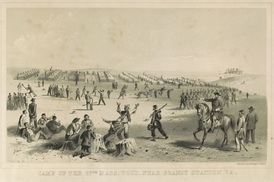 Camp of the 37th Mass. Vol's. near Brandy Station, Va.
 Oct. 18, 2011
Hi Kathy, I'll tell you a little about how I acquired Edwin's ID badge. I have been in the hobby of Civil War relic hunting for over 40 years. I now run a small business here in Virginia that holds annual events where relic hunters from all over the country come to relic hunt private property where Civil War activity took place.
There are those that think relic hunting is stealing history and they call us looters and pot hunters. I feel very differently about that. If we didn't recover these artifacts they would never be seen or held again. These areas are remote and the archaeologists will never have the
funding, time or even a reason to excavate these little camps. The land will soon be put into conservation easements never to be developed. We are lovers of history and many of us have a ball sharing our passion with schoolchildren and interested groups.
I have a presentation coming up at Culpeper Christian School and want to concentrate on the 37th Mass. Regiment -- hence my interest in Sgt. Edwin Graves. The look on children's faces when they actually get to hold an artifact from the Civil War is priceless!
During our Spring event we located the 1863/64 winter encampment of the 37th Mass. Infantry Regiment. There is a period lithograph [at right] depicting the camp and you can stand on the spot where the artist made his drawing and it looks very much the same as it did 147 years ago. Gives me cold chills.
Hi Kathy, I'll tell you a little about how I acquired Edwin's ID badge. I have been in the hobby of Civil War relic hunting for over 40 years. I now run a small business here in Virginia that holds annual events where relic hunters from all over the country come to relic hunt private property where Civil War activity took place.
There are those that think relic hunting is stealing history and they call us looters and pot hunters. I feel very differently about that. If we didn't recover these artifacts they would never be seen or held again. These areas are remote and the archaeologists will never have the
funding, time or even a reason to excavate these little camps. The land will soon be put into conservation easements never to be developed. We are lovers of history and many of us have a ball sharing our passion with schoolchildren and interested groups.
I have a presentation coming up at Culpeper Christian School and want to concentrate on the 37th Mass. Regiment -- hence my interest in Sgt. Edwin Graves. The look on children's faces when they actually get to hold an artifact from the Civil War is priceless!
During our Spring event we located the 1863/64 winter encampment of the 37th Mass. Infantry Regiment. There is a period lithograph [at right] depicting the camp and you can stand on the spot where the artist made his drawing and it looks very much the same as it did 147 years ago. Gives me cold chills.
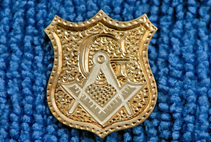 Images by Divido; Courtesy of John Kendrick
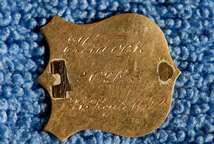
 There were many artifacts recovered at that event and one of them was Edwin Graves gold ID shield. It is absolutely beautiful. Solid gold with a white gold or platinum square in the Masonic emblem on the front. The back is a little hard to read, but says "E Graves, Co F, 37th Regt. Volunteers.” It's about the size of a dime.The pin obviously broke and he lost the shield while there. The 37th left that camp on May 3rd, 1864 and marched south on the Plank Road. Edwin was wounded on May 6th and died in Fredericksburg on May 21st.
The ID shield was recovered by a young man on the second day of our 3 day event and it was the best find of the event by far. He has since found it necessary to part with it. He wanted more for it than I could afford to pay but I simply couldn't bear the thought of someone buying it to make a profit and it falling into someone's hands who didn't appreciate the pin for what it was and the history behind it. The young man had tears in his eyes and his hands trembled when he handed it to me. It's now in my collection and will remain there as long as I am around.
The ID shield was recovered by a young man on the second day of our 3 day event and it was the best find of the event by far. He has since found it necessary to part with it. He wanted more for it than I could afford to pay but I simply couldn't bear the thought of someone buying it to make a profit and it falling into someone's hands who didn't appreciate the pin for what it was and the history behind it. The young man had tears in his eyes and his hands trembled when he handed it to me. It's now in my collection and will remain there as long as I am around.
 Images by Divido; Courtesy of John Kendrick
 I have found quite a few references to Edwin. The best one is from Recollections of the Civil War by [Mason Whiting] Tyler, printed by Putnam and Sons in 1912. You can read it online and on page 146, Capt. Tyler writes almost a whole page on Graves. Another is The Civil War Letters of Joseph K. Taylor of the Thirty Seventh Massachusetts Volunteer Infantry by Kevin C. Murphy. Taylor was Graves hut-mate the winter of 1863/64 and mentions him numerous times in his letters home.
I am interested in any information on Graves. I will most likely travel to Hatfield this coming Spring and would love to show you the shield. I want to visit his grave and maybe see his home if still standing.
By recovering and documenting artifacts for present and future generations to see and hold, not simply to be measured, recorded and put into some warehouse somewhere never to be seen again, we are doing some good.
Our business maintains a forum called mytreasurespot.com. My wife and I run the forum and business. We work very hard to run a decent organization and have donated close to
$100,000 in seven years to Civil War and community-based charities. We took donations for our local food closet at a recent event and collected 7,500 items for the closet. The money we give landowners for the event helps improve the farm operations in our area and pay taxes for some struggling farmers.
I have retraced [Edwin’s] steps south from the camp to the place of his wounding. Much of the landscape is unchanged today and sometimes I can almost feel his presence...the more I learn about him, the more he becomes alive for me. History is wonderful and I have a wonderful hobby! Thank you for your interest Kathy.
--John
I am interested in any information on Graves. I will most likely travel to Hatfield this coming Spring and would love to show you the shield. I want to visit his grave and maybe see his home if still standing.
By recovering and documenting artifacts for present and future generations to see and hold, not simply to be measured, recorded and put into some warehouse somewhere never to be seen again, we are doing some good.
Our business maintains a forum called mytreasurespot.com. My wife and I run the forum and business. We work very hard to run a decent organization and have donated close to
$100,000 in seven years to Civil War and community-based charities. We took donations for our local food closet at a recent event and collected 7,500 items for the closet. The money we give landowners for the event helps improve the farm operations in our area and pay taxes for some struggling farmers.
I have retraced [Edwin’s] steps south from the camp to the place of his wounding. Much of the landscape is unchanged today and sometimes I can almost feel his presence...the more I learn about him, the more he becomes alive for me. History is wonderful and I have a wonderful hobby! Thank you for your interest Kathy.
--John
Childs’ Finders Keepers is about exactly this conundrum: leave it in the ground where it
will likely rot and never be seen by anyone? Or be covered by a mall parking lot or development? Or, dig it up, either by archaeologists or relic hunters and a) pack it away in a drawer in a university archive? b) sell it to the highest bidder, who may be a private collector and keep the artifact to themselves or c) share it (in some fashion) with others interested in history? The author does not come down cleanly on any side, except on the value of provenance.
To my mind, what John Kendrick and others like him are doing here – searching out and sharing background and detail, the provenance, effectively, that had been lost – is what makes history come alive -- and not just for kids.
P.S. Speaking of provenance, here’s a post from a blog called “Touch the Past,” where a relic hunter recommends taking a GPS reading of your find so you don’t lose the historical value of its placement in the ground. Now that seems like something folks could agree on.
will likely rot and never be seen by anyone? Or be covered by a mall parking lot or development? Or, dig it up, either by archaeologists or relic hunters and a) pack it away in a drawer in a university archive? b) sell it to the highest bidder, who may be a private collector and keep the artifact to themselves or c) share it (in some fashion) with others interested in history? The author does not come down cleanly on any side, except on the value of provenance.
To my mind, what John Kendrick and others like him are doing here – searching out and sharing background and detail, the provenance, effectively, that had been lost – is what makes history come alive -- and not just for kids.
P.S. Speaking of provenance, here’s a post from a blog called “Touch the Past,” where a relic hunter recommends taking a GPS reading of your find so you don’t lose the historical value of its placement in the ground. Now that seems like something folks could agree on.