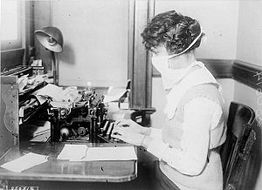
 New York City typist, Oct. 16, 1918. Source: National Archives
 By Deb Blodgett
If you were a child skipping rope in Hatfield in 1918, you might have recited this popular rhyme:
I had a little bird,
Its name was Enza.
I opened the window,
And in-flew-enza.
The year 1918 marked the beginning of a worldwide epidemic that later became known as the Influenza Pandemic of 1918-1919. While it is easy to think that this epidemic only impacted large overcrowded cities, this simply was not the case. Hatfield, like many small rural towns, was not left unscathed.
Although the disease was called the “Spanish Flu,” the name was a misnomer. During World War I, the United States and several European countries censored news about the influenza epidemic, fearing additional panic or adverse impact on soldier morale. During the war, Spain remained neutral, which resulted in its newspapers freely reporting news of the influenza epidemic. This incorrectly led many to believe Spain was the origin of the disease, or more severely impacted than other countries, which was not the case. In fact, an estimated one-third of the world’s population, about 500 million, became infected and the total deaths due to influenza were tallied between 50 and 100 million people during the approximately six months of the pandemic spanning late 1918 and early 1919. About 675,000 of these deaths occurred in the United States.
If you were a child skipping rope in Hatfield in 1918, you might have recited this popular rhyme:
I had a little bird,
Its name was Enza.
I opened the window,
And in-flew-enza.
The year 1918 marked the beginning of a worldwide epidemic that later became known as the Influenza Pandemic of 1918-1919. While it is easy to think that this epidemic only impacted large overcrowded cities, this simply was not the case. Hatfield, like many small rural towns, was not left unscathed.
Although the disease was called the “Spanish Flu,” the name was a misnomer. During World War I, the United States and several European countries censored news about the influenza epidemic, fearing additional panic or adverse impact on soldier morale. During the war, Spain remained neutral, which resulted in its newspapers freely reporting news of the influenza epidemic. This incorrectly led many to believe Spain was the origin of the disease, or more severely impacted than other countries, which was not the case. In fact, an estimated one-third of the world’s population, about 500 million, became infected and the total deaths due to influenza were tallied between 50 and 100 million people during the approximately six months of the pandemic spanning late 1918 and early 1919. About 675,000 of these deaths occurred in the United States.
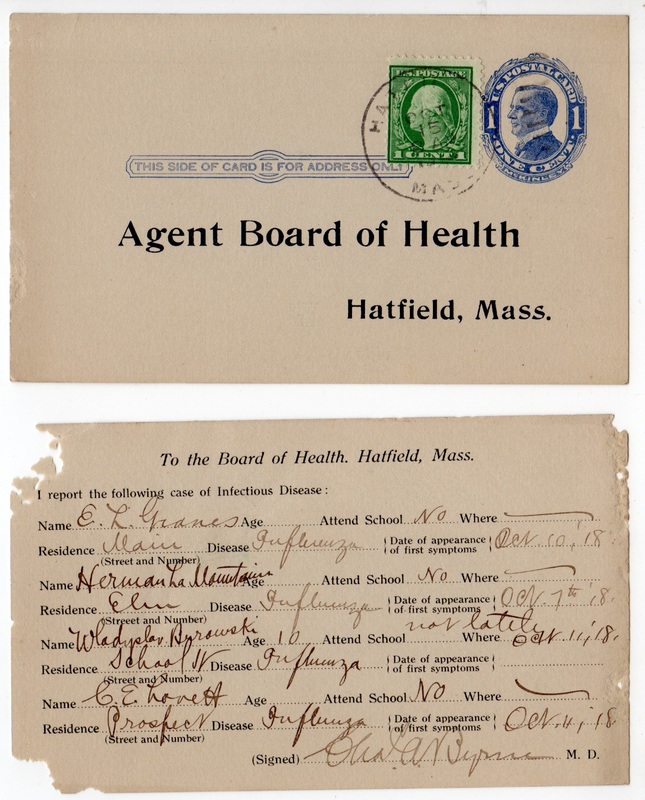 October 1918 notice of influenza cases. Click for larger image.
 In Massachusetts, it was conservatively reported that 400,000 became infected between September and December of 1918. As many physicians and nurses were enlisted in the military, the number of available medical professionals available to battle this illness was reduced. In addition, hospital facilities throughout the state were sorely unprepared to accommodate the sizable number of cases, prompting the establishment of about 50 emergency hospitals throughout the state. The most dramatic impact occurred in October 1918 with an average of 418 deaths occurring per day. The total Massachusetts deaths attributable to influenza in 1918 totaled 13,783. However, an additional 4,643 deaths listed influenza as a secondary cause of death, bringing the total impact of influenza-related deaths to 18,426. In 1919, there were 2,872 deaths attributable to influenza. The expense to the Massachusetts government in fighting the influenza outbreak amounted to about $100,000 in 1918. (That would be about $1.6 million in today’s dollars.)
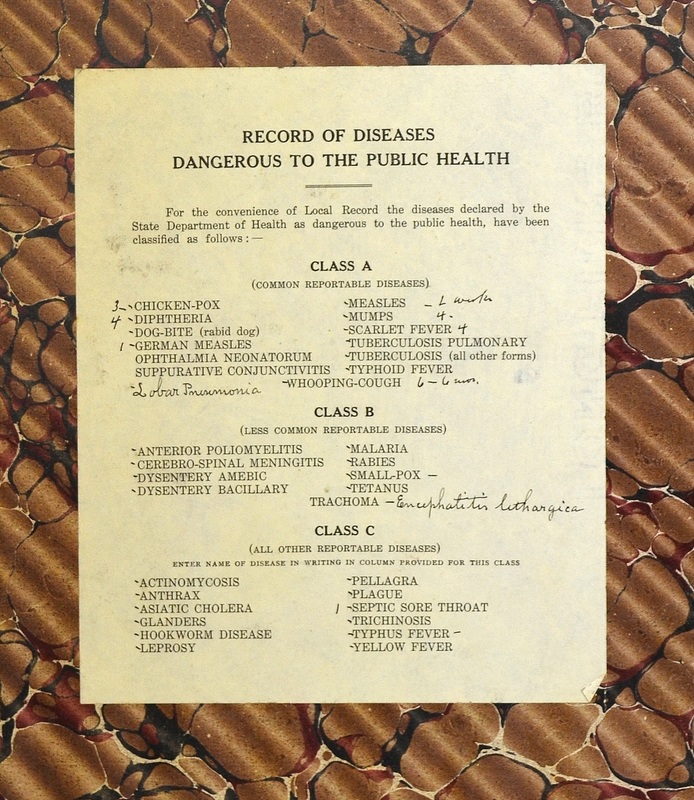 Inside cover, Hatfield's Dangerous Diseases record book
 Beginning in 1884, Massachusetts law required town board of health officials to keep a record of residents infected with diseases deemed dangerous to public health. Bound books were provided by the state printing office to each town for this purpose so as to provide consistency in data reporting. These log books included spaces to record the disease contracted, as well as the impacted individual’s name, age, occupation, address, reporting individual, and disposition. However, before September 1918, influenza was not one of the reportable diseases as it was not considered dangerous to public health before the 1918 strain.
Fortunately, the Record of Dangerous Diseases, Town of Hatfield, still exists, thus allowing us to examine how the town was impacted by the epidemic. Hatfield’s first reported case of influenza occurred on Oct. 8, 1918, infecting a 26-year-old male. By Dec. 31, a total of 364 residents had contracted the illness, nearly 14% of the town’s population. An additional 53 cases occurred in the first few months of 1919, with the last cases being reported on March 24, 1919. A total of 417 residents became ill during the six months of the epidemic (see below):
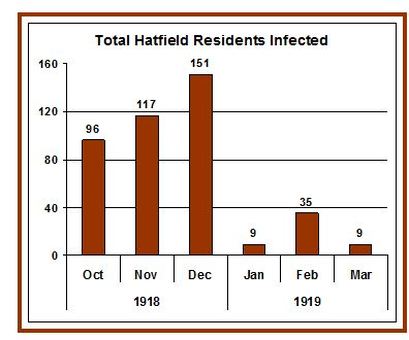
A total of 417 residents contracted influenza in the six months of the epidemic.
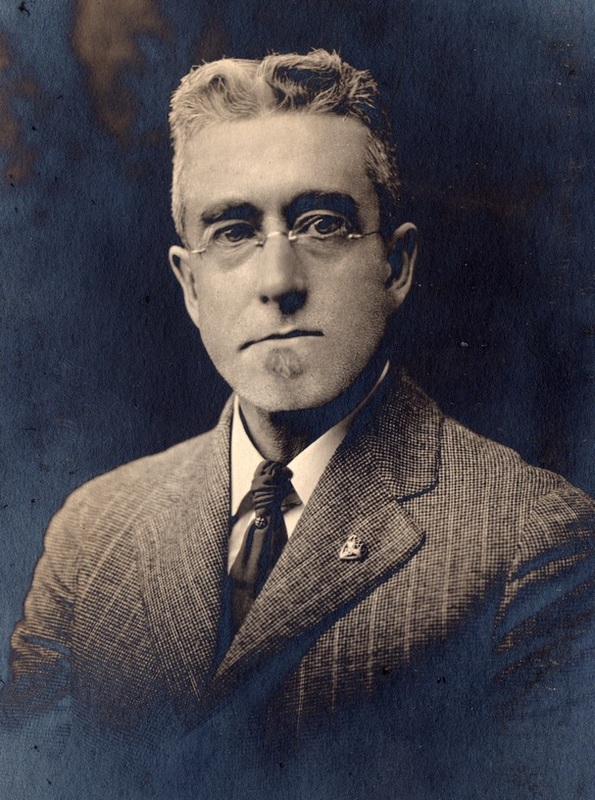 Dr. C. A. Byrne, c. 1915
 One of Hatfield’s two in-town physicians, Dr. Charles A. Byrne, treated 82% of the town’s infected residents with the remaining residents being treated by doctors from Northampton and other area towns. The town’s other in-town doctor, Dr. Alfred Bonneville, was away serving in World War I in the Medical Corps. While not all of the residents’ ages were reported, of those that were, the youngest patient was 9 months old and the eldest patient was 50 years old. It is likely that most infected patients were between the ages of 20 and 40, which is the typical age group that this strain of influenza affected.
Hatfield was fortunate that the majority of its impacted residents recovered. Influenza-related deaths were low, with six deaths having occurred in 1918 (although, as discussed above, an additional five deaths may have had influenza as a contributing factor) and no deaths by influenza in 1919.
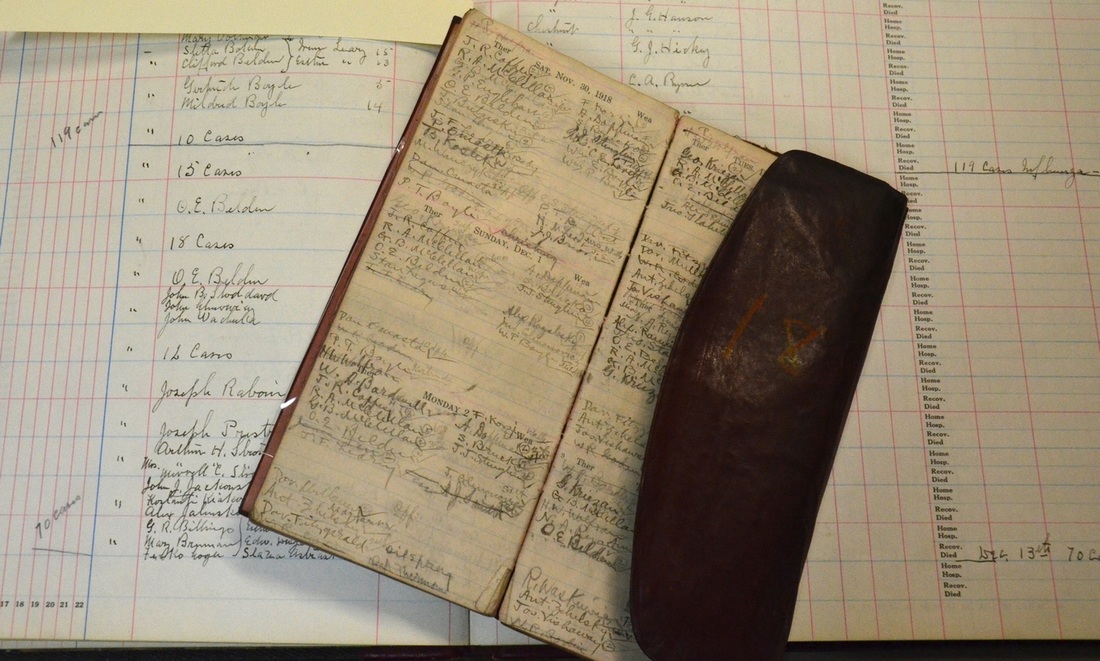
Dr. C.A. Byrne's appointment book, Nov. 30-Dec. 2, 1918, and the Town of Hatfield's influenza record.
Deb Blodgett is a volunteer at the Hatfield Historical Museum. She enjoys historical and genealogical research, and her interests include the study of artifacts, industries and family life of rural 19th century New England.
*For more information about health care in Hatfield in the first half of the 20th century, check out the following post about our Mass Humanities Scholar in Residence Grant as well as a guest blog post by our summer Scholar in Residence, UMass PhD candidate Ann Robinson, and visit the Hatfield Historical Museum’s current exhibit “From House Calls to Hoaxes: The Changing Face of Health Care in Hatfield.”
*For more information about health care in Hatfield in the first half of the 20th century, check out the following post about our Mass Humanities Scholar in Residence Grant as well as a guest blog post by our summer Scholar in Residence, UMass PhD candidate Ann Robinson, and visit the Hatfield Historical Museum’s current exhibit “From House Calls to Hoaxes: The Changing Face of Health Care in Hatfield.”

Sources:
1. Jeffery K. Taubenberger and David M. Morens, “1918 Influenza: the Mother of All Pandemics”, Emerging Infectious Diseases, 12:1 (2006): 15-22.
2. Laura Stephenson Carter, “Cold Comfort,” Dartmouth Medicine, (Winter 2006): 36-57.
3. Harold D. Wilson, ed., Seventy-Seventh Annual Report on the Vital Statistics of Massachusetts…for the Year 1918 (Boston: Wright & Potter Printing Co., 1920), 94, 180, 190, 199, 241.
4. Annual Report on the Vital Statistics of Massachusetts…for the Year 1919 (Boston: Wright & Potter Printing Co., 1921), 99, 191.
5. The Revised Laws of the Commonwealth of Massachusetts Enacted November 21, 1901 … (Boston: Wright & Potter Printing Co., 1902), Chapter 75, Section 51, 666.
6. Fourth Annual Report of the State Department of Health of Massachusetts (Boston: Wright & Potter Printing Co., 1919), 3-6.
7. Record of Diseases Dangerous to Public Health, Town of Hatfield, 1915-1944, original manuscript, Hatfield, Massachusetts.
1. Jeffery K. Taubenberger and David M. Morens, “1918 Influenza: the Mother of All Pandemics”, Emerging Infectious Diseases, 12:1 (2006): 15-22.
2. Laura Stephenson Carter, “Cold Comfort,” Dartmouth Medicine, (Winter 2006): 36-57.
3. Harold D. Wilson, ed., Seventy-Seventh Annual Report on the Vital Statistics of Massachusetts…for the Year 1918 (Boston: Wright & Potter Printing Co., 1920), 94, 180, 190, 199, 241.
4. Annual Report on the Vital Statistics of Massachusetts…for the Year 1919 (Boston: Wright & Potter Printing Co., 1921), 99, 191.
5. The Revised Laws of the Commonwealth of Massachusetts Enacted November 21, 1901 … (Boston: Wright & Potter Printing Co., 1902), Chapter 75, Section 51, 666.
6. Fourth Annual Report of the State Department of Health of Massachusetts (Boston: Wright & Potter Printing Co., 1919), 3-6.
7. Record of Diseases Dangerous to Public Health, Town of Hatfield, 1915-1944, original manuscript, Hatfield, Massachusetts.