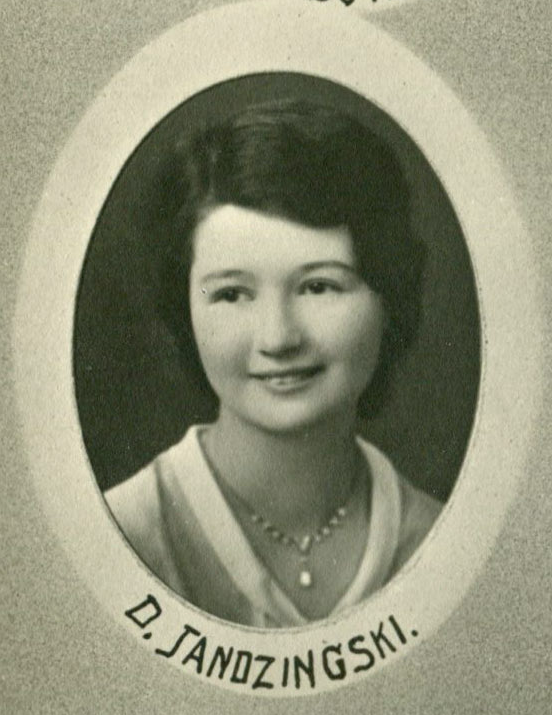
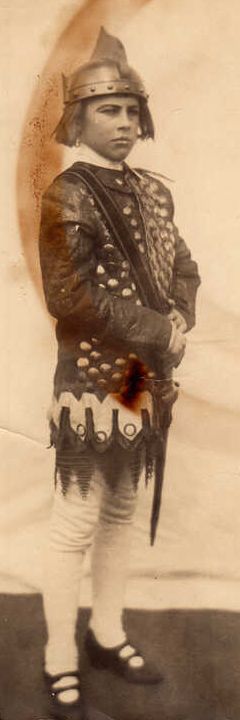
 | In early 1894, young Reuben Wells kept a diary. It covered his daily activities, school work, and family interactions. He records lists of books he had presumably read, a bit of accounting, and a list of veterans of the Civil War in which his father fought. Except none of those veterans are real. What he did not note down was why he recorded these things. Was it a school assignment, much like ones students still do today? Was it to be in keeping with so many of the adults around him, including his father? Was it just for fun? We may never know, but due to volunteer transcriptionist Sue Maciorowski, we can read the diary, as well as her research into his life HERE |
|
0 Comments
Research and article by Sue Maciorowski, HHM volunteer As part of the Digital Volunteers, Sue transcribed the diary she writes about here, and has done stellar research into the Jandzinski family history connected to this item.
by Rob Wilson, Hatfield Historical Society Board member When Liz Denny set out to clear brush and tidy up her back yard last October, she found more than fallen leaves and twigs. Her rake scraped over a flat stone that lay under a few inches of loose dirt and leaves. A closer inspection revealed that this was no ordinary rock. The small rectangular marble slab appeared to be a gravestone. As she brushed away the dirt, the name “Alice” emerged. The stone and the inscription had been worn away by age and the elements. It looked, to the amateur genealogist, as though it dated to the 19th Century, a time when smaller stone slabs often were to mark children’s graves. Click here to read what Liz discovered, and what her wife, songwriter Julie Pokela, wrote in tribute to little Alice's story. 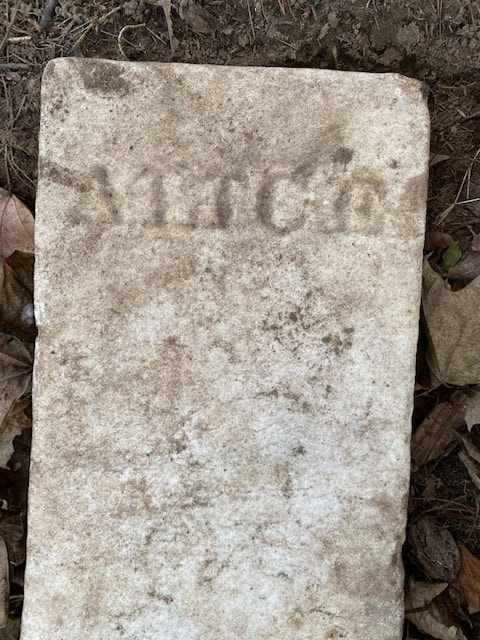 By George Vachula Last summer’s donation of a group of documents to the Hatfield Historical Museum by W. Michael and Judy Ryan included an important primary source document – the 1813 contract with Amos Pratt for Whately’s southwest district schoolhouse. It shows the formality and level of specification used at the time for a town building. It records who specified it, who built it, what it should look like, when and where it should be built and its cost to the town. (Click HERE to learn what the contract specified for our sister town of Whately, who was involved and what happened to the schoolhouse that preceded it -- along with the actual document and a transcription.) 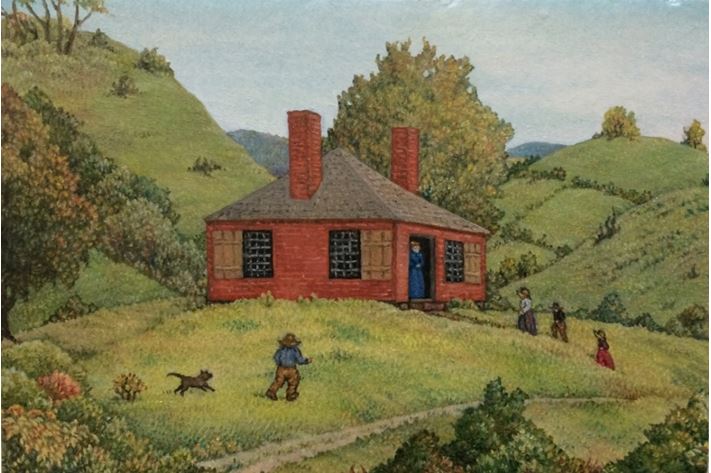 Whately Southwest Schoolhouse (Interpretation) - Oil Painting by Monica Vachula It didn’t take long. Our new website showcasing the late 19th century images of “The Lost Slides of L.H. Kingsley” was posted just a few days before our first ID came in of an unidentified slide. I thought the shell of a large building might have been from a big city somewhere in New England. Turns out it was in our own back yard -- it’s the MAYNARD HOE FACTORY of Northampton! On the website, which includes more than 200 images, you’ll find it under Box One – Miscellaneous, #11. 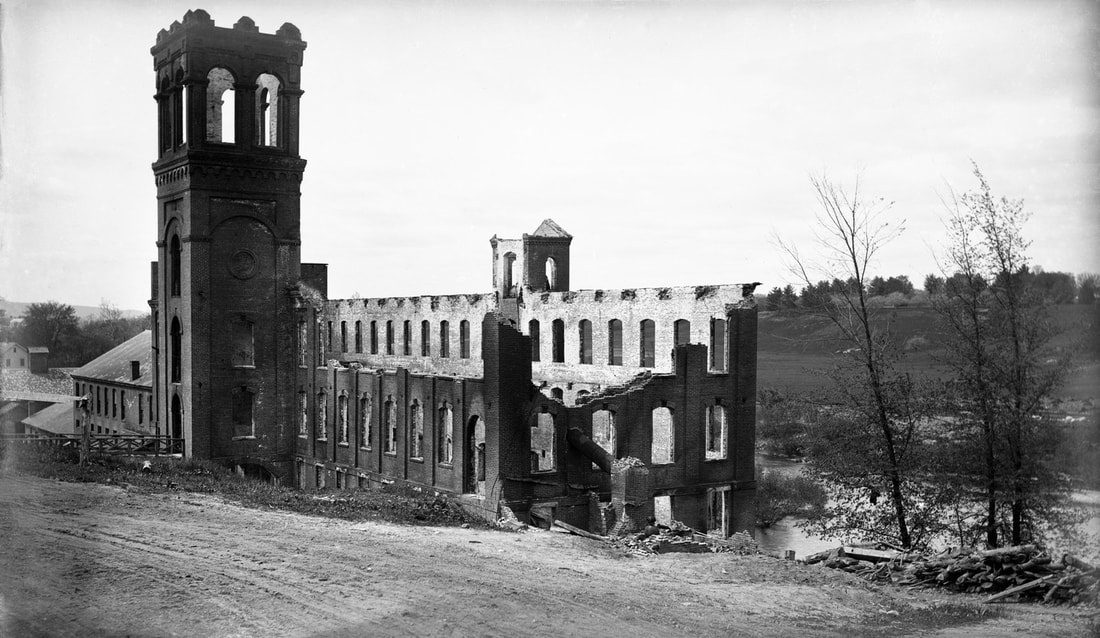 Maynard Hoe Factory, circa 1880s, by L.H. Kingsley, Hatfield Historical Museum Collection Here’s what we learned from our researcher: It was located about where the Smith College Faculty Club is now at the end of Green St. and just below the Paradise Pond dam. Forbes Library has a picture on its website HERE: (As a side note, this is near where Northampton's mill was located in the 1600s.) Here’s a shot from the other side, circa 1885, when the dam was being rebuilt, from Forbes Library's Digital Commonwealth site: 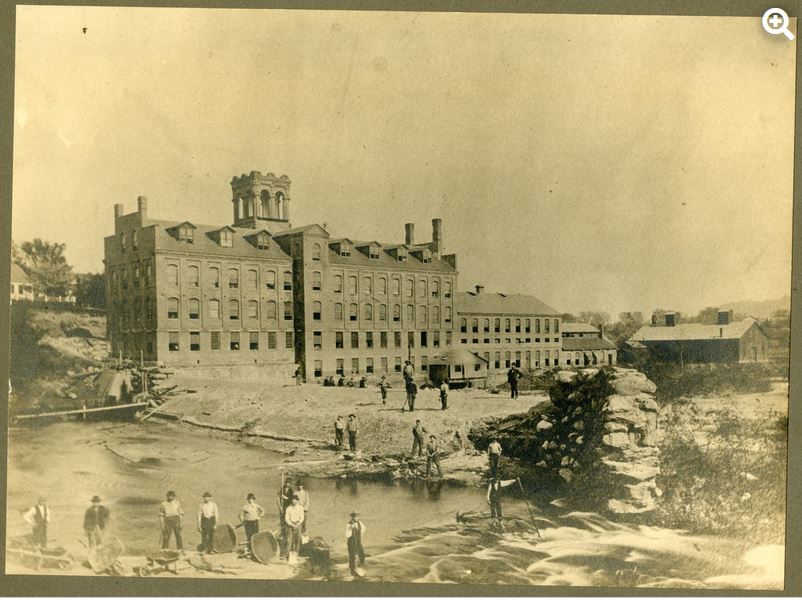 Maynard Hoe Factory, c. 1885, from Forbes Library Digital Commonwealth site A History of the Mill River in Northampton that includes the following description of the Maynard Hoe Factory may be found HERE:
"At the Lower Mills, the site of Northampton’s first grist mill, a series of entrepreneurs from basket makers to wire factories to hoopskirt makers appeared and disappeared. The grist and sawmills of Upper Mills at Paradise Pond burned down in the 1850s, but two owners of a cutlery in Bay State, Maynard & Clement, built a large hoe factory in 1866 at Paradise Pond. The factory was plagued with financial, flood, and fire problems, and burned for the last time in 1919. A factory building remains at the Lower Mills, but there is no sign of the Hoe factory." The following PDF identifies the location of the building on the Smith College campus. And on this interactive website from Smith College, you’ll find three images of the factory, plus shots of what it looks like today. Look what we have learned, prompted by L.H. Kingsley’s unidentified shell of a factory. Can you tell us about any of the other slides in the collection? Check out the rest of the images HERE, where you’ll also find out how this treasure trove was discovered and donated back to the town where the images began. Compiled by Kathie Gow, curator of the Hatfield Historical Museum To highlight our upcoming March 18, 2021, live-streaming virtual program on the Fabulous Falcons of Smith Academy (see Events page for signup info), we have two anniversary reflections written by Garry Brown. Part 1, reprinted from 2011, ran earlier this week. By Garry Brown I covered high school sports for The Springfield Union and Sunday Republican for 14 years, and, without question, my time writing about Smith Academy's Fabulous Falcons was the most memorable and enjoyable part of that. What a story. A tiny school in Hampshire County puts together two teams that travel to the big city (Springfield) and win the Western Massachusetts Interscholastic Basketball Tournament two years in a row. No school had won the tournament back to back until those Smithies did it. And no small school had ever won it until they came along in March of 1960. "Hoosiers" all over again. 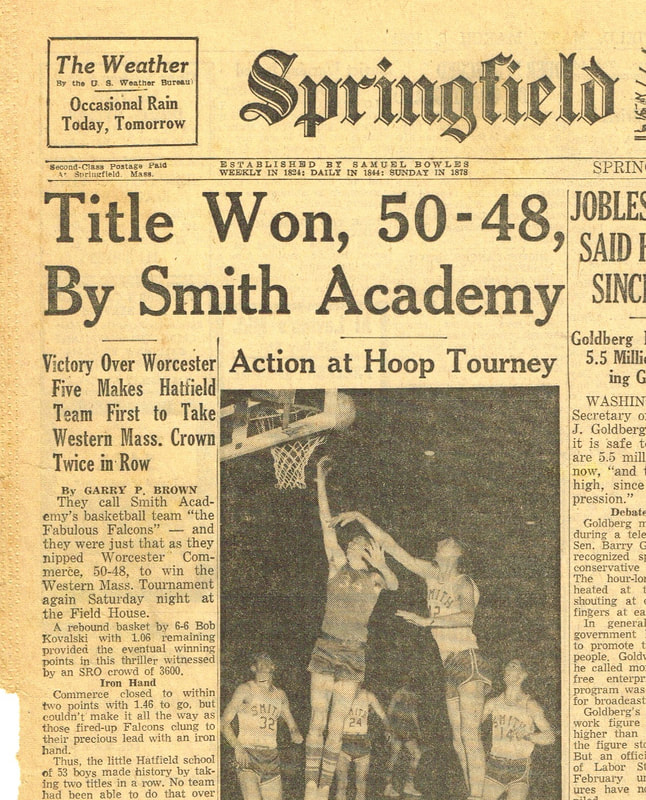 Springfield Union, March 5, 1961. From newspaper collection donated by Rose Kovalski Mulherin.  As high school beat writer for the Springfield Newspapers, my focus had to be on city basketball and the Valley League, both involving large schools. However, we city folks soon began to realize that something big was happening up country. Smith not only kept winning, it was doing so with the most dominant player in Western Mass.
That would be Bob "Jingles" Kovalski, a 6-foot-6 (some say he actually was 6-foot-8) junior whose scoring feats began attracting the region's attention. Ten games into the season, he was averaging 29.2 points per game. Then came a 40-point game against arch-rival Hopkins Academy and a 50-point game against St. Michael's of Northampton. By then, Smith was blowing out Hampshire League rivals, twice scoring 101 points. The Western Mass. Tournament committee took careful note of Smith's 19-1 record and the scoring of "Jingles," and gave them a berth in a field that also featured defending champion Holyoke, city champ Cathedral, Berkshire County's top two, Adams and Pittsfield, and Worcester County king St. John's of Shrewsbury. Meanwhile, coach John Skarzynski was preparing his little powerhouse for action on the big stage at the Springfield College Field House, site of the WMass tourney since 1948. He arranged for scrimmages at Deerfield Academy and Longmeadow High School so his team could get used to playing on big floors (as opposed to its little home court at the Hatfield Town Hall). The Smithies adjusted well. They soon realized that they were even better on a big floor, and were ready for the Field House. They drew Adams as their quarterfinal foe, and went into the game a bit jittery. They quickly fell behind 10-0, and I wondered – are they out of their league? Not so. They scored the next four points, and it became a duel to the wire. Smith won 44-43, leaving the capacity crowd emotionally drained. If that was a cliff-hanger, the next one was even more so. Facing a St. John's team that figured to be a big favorite, Smith again took it to the wire, winning 59-58 to reach the championship round. Another capacity crowd - including just about everybody from Hatfield - saw that one. The 1960 final actually was the easiest of Smith's tournament games. Matched against a Pittsfield team that featured super soph Mark Belanger, Smith maintained control throughout and won 65-57. Kovalski made most of the key points, but he also had a dedicated supporting cast that included Ken Kulesza, Tony Symanski, Jim Southard, Ed Malinowski, Jim Majeskey and Billy Celatka. Although Smith lost a lot of seniors to graduation, the 1960-61 team still had Kovalski. New coach Max Moczulewski built another top team around "Jingles," with Billy Celatka, Terry Michaloski, Marty Wilkes, Charlie Symanski and Bernie Pelis playing key roles. Smith went 19-0, with Kovalski having a 63-point game that set a new record for a Western Mass. player. The Falcons went back to the tournament, and pounded Lee 78-37 in the quarterfinals. From there, they knocked off Worcester South 49-43, then went back to their heart-stopping mode in a 50-48 championship victory over Worcester Commerce. The scoring of Kovalski was crucial, but so was the dogged defense that Celatka and his mates played to stifle W-Commerce's top player, Paul Ranucci. Smith ended each of those seasons with a loss in the New England Tournament, but their WMass tourney play endeared them to the region's rabid basketball fans and earned them a special place in the Connecticut Valley's basketball history. Yes, they were "Hoosiers" all over again - twice. Award-winning sportswriter Garry Brown joined The Springfield Union's sports department in 1950 at the age of 18, and went on to a 59-year sportswriting career, all of it as an employee of The Springfield Newspapers. In 1973 he started writing a weekly "Hitting to All Fields" column, which has become his signature work, still going 47 years later. Brown retired from full-time work in 2009, but continues to contribute columns and feature articles to The Springfield Republican as a freelance writer. His book, Garry Brown's Greatest Hits, was published in 2016 and includes a chapter about Smith Academy's championship teams of 1960 and ’61. To highlight our upcoming March 18, 2021, live-streaming virtual program on the Fabulous Falcons of Smith Academy (see Events page for signup info), we have been given permission to re-run this Garry Brown article by The Republican/ Springfield, MA. Part 2, a retrospective written by Garry last month, will run later this week. Posted Mar 12, 2011 (and updated Mar 25, 2019) 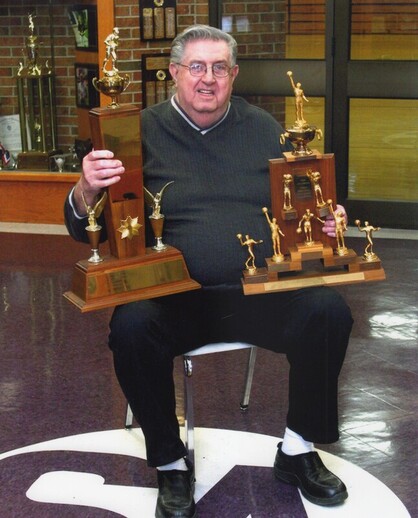 At left, Bob "Jingles" Kovalski of Hatfield holds the 1960 and 1961 Basketball Championship Trophies won by teams he played on at Smith Academy in Hatfield. Photo by Jeff Brown By Garry Brown | Special to The Republican Fifty years ago, Western Massachusetts had its own version of “Hoosiers.” Just like Gene Hackman’s team from that memorable 1986 movie, the players came out of a small town to win a big-time championship. They were the “Fabulous Falcons” of Smith Academy, a Hatfield school with only 57 boys in grades seven through 12. This is golden anniversary time for those Smithies, who twice stormed the old field house at Springfield College to win the Western Massachusetts Tournament. Until Smith’s remarkable run, no small school had ever won this region’s biggest basketball tourney – and no school had ever won it twice in a row. (to continue reading, click HERE.) This profile by George Vachula was researched with help from primary sources in a document collection recently donated to the Hatfield Historical Museum by W. Michael and Judy Ryan, as well as by artifacts donated by Charles Wilkie, the subject's grandson, more than 100 years ago. It was prompted by our participation as an early contributor to the PVHN project and website, Revolution Happened Here, funded by Mass Humanities. Henry Wilkee was a Hessian soldier who fought with General Burgoyne’s army during the Revolutionary War. Following Burgoyne’s surrender after the battle at Saratoga Henry was taken prisoner. Although there are conflicting reports of how Henry came to reside in Hatfield, the story of his life and family is surely typical of the thousands of Hessian soldiers who came to fight, who chose to remain and who, through several generations of their families, prospered in their new land. An exhibition of historical artifacts was included in a celebration held in Hatfield in 1889 [1]. Charles Wilkie [2], then a prosperous resident of Hatfield and the grandson of Henry, the Hessian soldier, donated several items to that exhibition. One of these items was the powder horn Henry was believed to have obtained and possibly used during his time as a soldier in Burgoyne’s army. This simple, utilitarian horn, along with several items from Henry’s household, resides today in the Hatfield Historical Museum. To read Henry's story (and why there are two different spellings of his last name), click HERE. 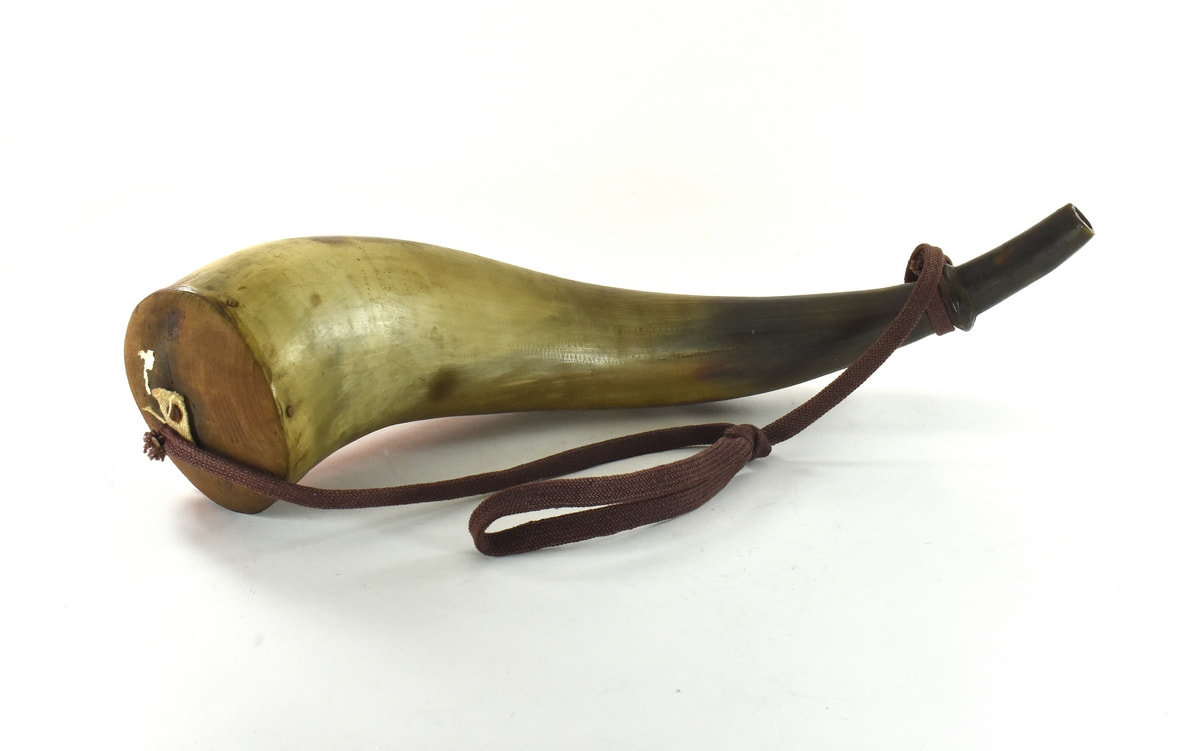 Powder horn, circa 1777, that belonged to Henry Wilkee, Hessian soldier during the Revolutionary War. Donated by Charles Wilkie, the owner's grandson. 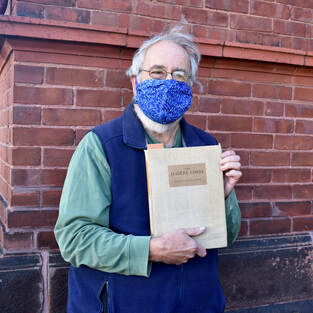 John Nove of Grey Seal Bindery, delivering "The Hadley Chest" to the Hatfield Historical Museum. John Nove of Grey Seal Bindery, delivering "The Hadley Chest" to the Hatfield Historical Museum. Collection items come to us in all sorts of ways. Sometimes it is just one person donating an item from their home that they think will help tell a story about the history of our town. Sometimes we find a Hatfield item on eBay and solicit a funder. Sometimes it is a collaborative effort, reflecting the generosity of several people. Like this one. “The Hadley Chest” by Clair Franklin Luther, published in 1935, first came to the attention of John Nove, a South Deerfield bookbinder, when it was brought to him by Ken Schoen of Schoen Books, also in South Deerfield. The book was part of a group of books needing repair from an estate sale in Amherst. John, who has previously brought books he’s repairing (that are for sale) to the attention of institutional collections, recognized that this book was of local historical significance. He contacted me, as the curator of the Hatfield Historical Museum, since “Hadley chests” describe a type of joined chest that was made in Western Mass (including Hatfield) in the late 1600s to 1730 or 1740. John has repaired and/or made protective boxes for a number of books in the Hatfield Historical Museum collection under the CPA-funded Museum Collections Management & Preservation Grant. Since our collection did not include a copy of this book, we were very interested. Though only one photographed chest listed a Hatfield owner, the author listed many Hatfield women who received chests as well as discussed likely Hatfield builders of the chests. What happened next was – Ken agreed to sell the book (with a damaged spine) at a VERY reasonable price; John volunteered to repair the spine at no cost; and an anonymous donor volunteered to fund the purchase. The book is numbered 131 out of the 525 copies printed 85 years ago. The book now resides in the collection of the Hatfield Historical Museum, where it can be enjoyed by all! Thanks to all three – John, Ken and our anonymous donor. In addition to running Grey Seal Bindery, John Nove is Chair of the Deerfield Historical Commission. He can be reached at [email protected]. Ken Schoen, owner of Schoen Books, https://schoenbooks.com/, is a former Deerfield Historical Commission member. 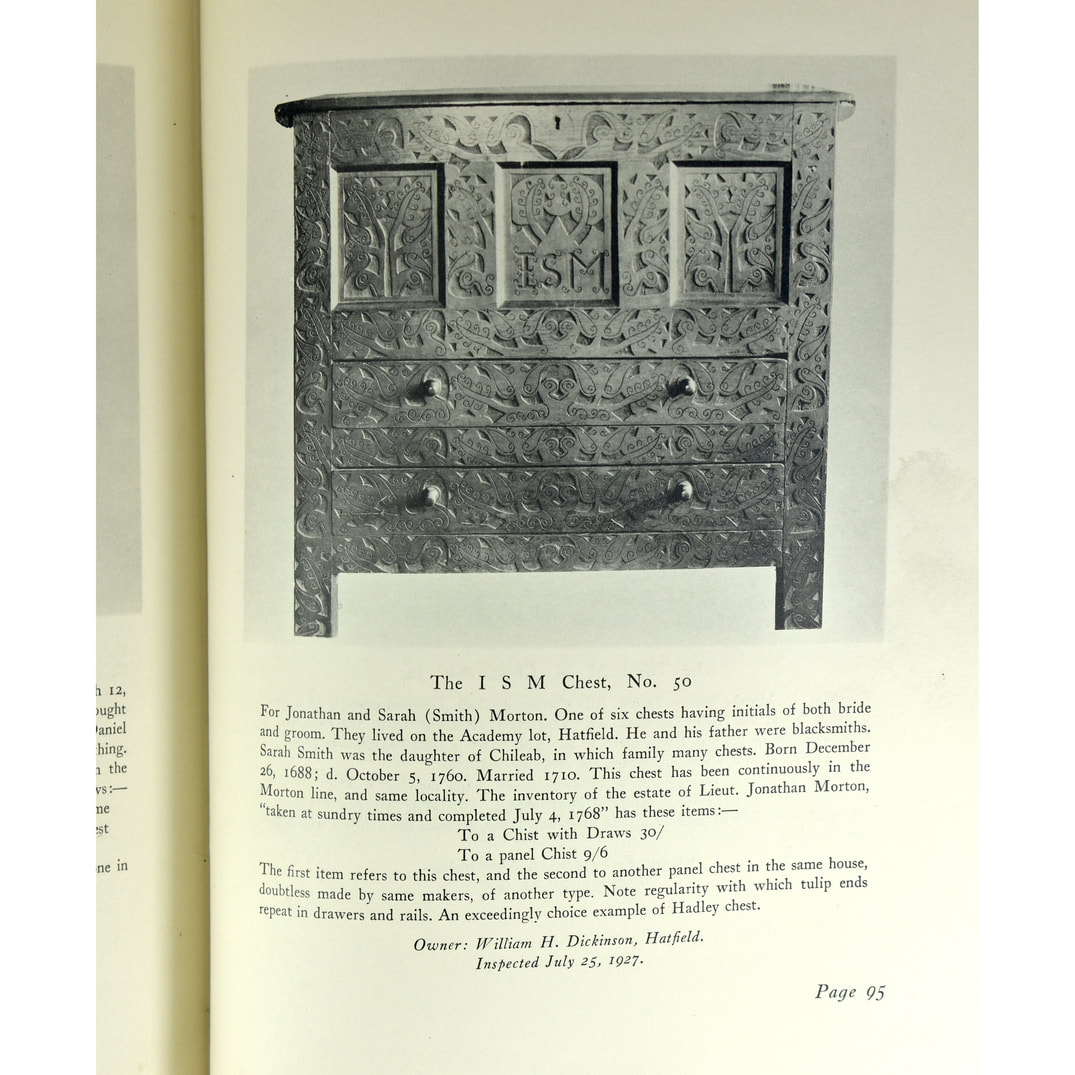 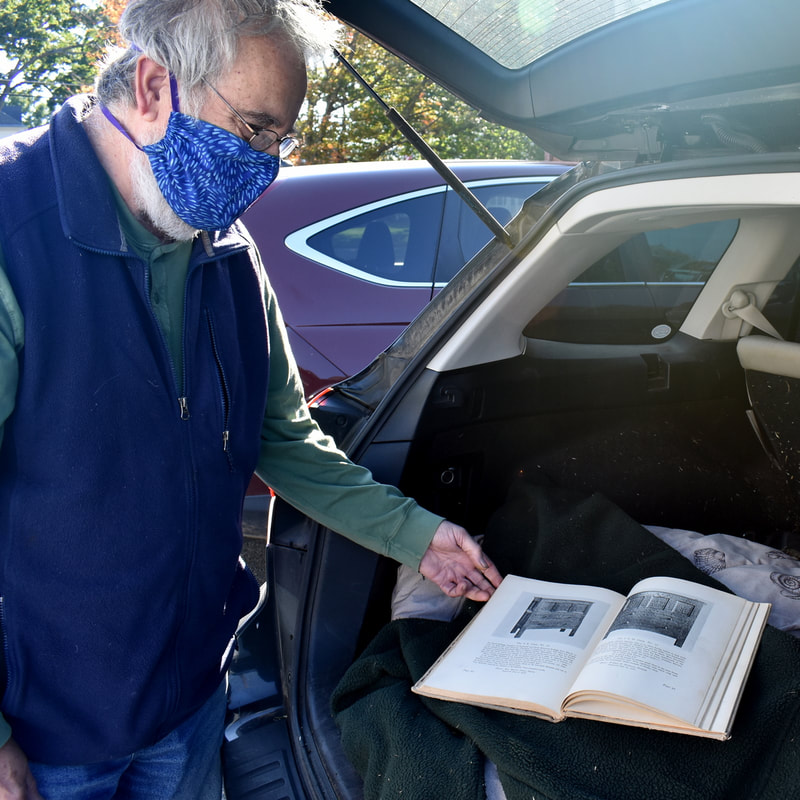 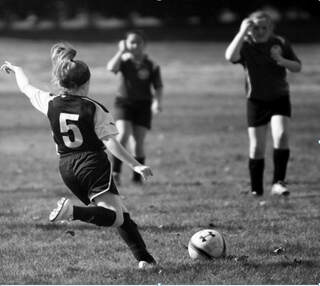 For some fascinating history of Hatfield sports from four decades ago, with lots of names you may recognize, check out this Guest Post. Both the first-place ribbon and the program bumper sticker have been added to our collection.
By Mike Ryan Coach & Program Director, 1979-1989 I had been a youth soccer coach in Northampton for four years when Judy and I and our four children, Luke, Molly, Maggie and Bridie, moved to 8 School Street, Hatfield in 1977. Having gone to St. Michael’s High School in Northampton, my varsity soccer team faced Smith Academy twice a year in soccer and lost, usually very badly, every time. In 1962, for example, Falcon Captain Marty Wilkes scored six or seven goals on us and we lost 12-0. Hence, I was surprised to discover there was no youth soccer program in Hatfield. In 1979, I decided to start one. My first order of business was to recruit Bill Burke. We were close friends and had worked together as probation officers for several years. He knew every person in Hatfield and could charm a hungry dog into sharing his bone. Bill’s son Bill was going into fourth grade and my son Luke was going into second so we decided on two leagues: 1st, 2nd and 3rd graders for the little kids’ league and 4th, 5th and 6th graders for the big kids’ league. At that time, there were junior high school sports so there was no need for an older kid’s league. Besides, as probation officers, we knew kids quit talking to adults at twelve or thirteen. Who wants to coach kids who just grimace and rolls their eyes at everything you say? To read more and find out how Hatfield's coed underdog team won the Eaglebrook Junior Soccer Tournament in 1985, click HERE. |